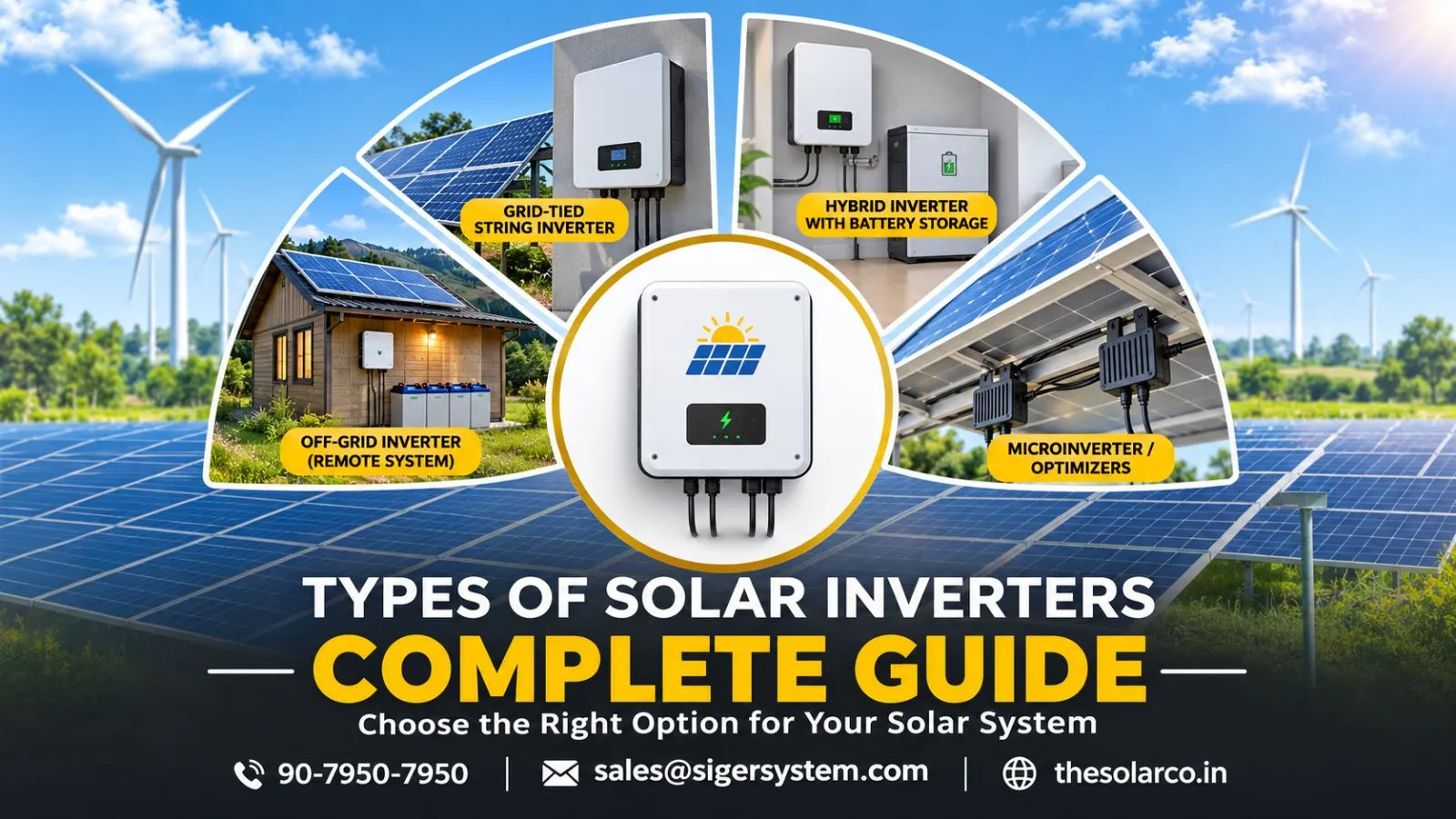
Choosing the right inverter is an important step when planning a solar power system for a home, business, or industrial facility. Understanding the types of solar inverters helps property owners select equipment according to electricity requirements, grid availability, backup expectations, and budget. The three main options are on-grid, off-grid, and hybrid solar inverters. Each system works differently and offers specific advantages depending on how electricity is generated, stored, and consumed. Before investing in solar energy, buyers should understand these differences to make an informed decision, improve energy management, and select a solution that supports their long-term electricity needs.
Understanding Different Types of Solar Inverters and Their Applications
A solar inverter converts direct current (DC) electricity generated by solar panels into alternating current (AC) electricity used by most household and commercial appliances. Different inverter configurations manage this conversion according to the property’s connection with the electricity grid and its requirement for battery storage.
Why Different Inverter Types Are Used
Every property has different electricity requirements. A home connected to a reliable electricity grid may benefit from an on-grid system, while a remote property without dependable grid access may require an off-grid configuration.
Some users also want the flexibility to use solar electricity, store excess energy in batteries, and access grid electricity when required. A hybrid inverter can support these requirements when designed with compatible equipment.
The main reasons for choosing different configurations include:
- Grid availability: Determines whether the system needs to operate independently or alongside the electricity network.
- Backup requirements: Identifies whether battery storage is necessary during power interruptions.
- Electricity consumption: Helps determine the appropriate inverter capacity and system configuration.
- Energy management: Influences how solar generation, battery storage, and grid electricity are utilized.
- Installation budget: Affects the choice of inverter, batteries, and supporting equipment.
Understanding these factors makes it easier to identify a suitable configuration instead of selecting equipment based only on its advertised capacity.
Role of Inverter in Solar Power Conversion
Solar panels generate DC electricity when sunlight reaches their photovoltaic cells. However, most electrical appliances and standard building electrical systems operate using AC electricity.
The inverter performs this essential conversion and manages the flow of electricity within the solar installation.
In grid-connected systems, it synchronizes the generated electricity with the utility supply. In battery-based configurations, compatible inverters can also manage charging and discharging according to system design.
Modern equipment may include Maximum Power Point Tracking (MPPT), electrical protection, communication connectivity, and generation monitoring.
These functions help improve energy utilization and provide information about system performance. The inverter also monitors important electrical conditions to ensure that the installation operates within its specified limits.
Choosing an Inverter Based on Application
The right configuration depends on where the solar system will be installed and how electricity will be used.
For residential properties with regular grid access, an on-grid inverter is often a practical option. It can help reduce electricity purchased from the utility by supplying solar-generated power during daylight hours.
Remote homes, agricultural properties, and locations with limited grid connectivity may require off-grid equipment with battery storage.
Commercial buildings, hospitals, offices, and industrial facilities may consider hybrid systems when backup and flexible energy management are important.
Before purchasing equipment, evaluate daily electricity consumption, peak loads, available installation space, grid conditions, and future expansion plans.
On Grid Solar Inverter
An on-grid solar inverter, also called a grid-connected inverter, operates alongside the electricity distribution network. It converts electricity generated by solar panels into AC power and synchronizes the output with the utility grid.
This configuration is commonly used in residential, commercial, and institutional rooftop solar installations where grid connectivity is available.
Working Process of Grid Connected Inverter
An on-grid inverter receives DC electricity from the solar panel array and converts it into synchronized AC electricity.
The generated electricity can first supply the connected property’s electrical loads. If solar production exceeds the property’s immediate consumption, the surplus may be exported to the electricity grid, subject to applicable net-metering or other approved regulations.
When solar generation becomes insufficient, electricity can be drawn from the grid to meet the remaining demand.
The process generally involves four stages:
- Solar panels generate DC electricity from sunlight.
- The inverter converts DC electricity into AC electricity.
- Connected appliances consume the available solar power.
- Surplus electricity may be exported according to the applicable grid arrangement.
A grid-connected inverter also monitors grid voltage and frequency. Its anti-islanding protection helps disconnect the inverter during a grid outage to prevent unsafe electricity supply to the utility network.
Therefore, a standard on-grid system does not provide backup electricity during a power cut.
Benefits and Limitations
On-grid systems are popular because they generally have a simpler configuration than battery-based solar installations.
Their major advantages include:
- Lower initial investment compared with many battery-supported configurations.
- No mandatory battery storage requirement.
- Efficient utilization of daytime solar generation.
- Potential reduction in electricity bills.
- Possibility of exporting surplus electricity under applicable regulations.
- Relatively straightforward monitoring and maintenance.
However, an on-grid inverter has important limitations.
The system normally shuts down during a grid failure, even when sunlight is available. This happens because grid-connected equipment must follow electrical safety requirements.
Its financial benefits also depend on electricity tariffs, approved export arrangements, system size, and local regulations.
Users who require uninterrupted backup during outages should consider an appropriately designed alternative.
Suitable Applications for Users
On-grid systems are suitable for properties that have reliable electricity connections and consume a significant amount of electricity during daylight hours.
Common applications include:
- Independent houses and residential buildings.
- Offices and commercial establishments.
- Schools and educational institutions.
- Retail stores and shopping complexes.
- Factories and warehouses with daytime operations.
For example, an office operating mainly between morning and evening can directly utilize solar electricity during working hours.
A properly designed system can help reduce grid electricity consumption while making better use of available rooftop space.
Off Grid Solar Inverter
An off-grid solar inverter is designed for installations that operate independently of the utility electricity network. It works with solar panels and battery storage to provide electricity according to the property’s energy requirements.
This configuration is useful in remote areas, agricultural locations, and properties where grid connectivity is unavailable or unreliable.
How Off Grid Inverter Systems Work
An off-grid solar installation generates electricity through photovoltaic panels and stores available energy in compatible batteries.
During daylight hours, solar panels supply electricity to connected loads while the system manages battery charging according to its configuration.
When solar generation decreases or becomes unavailable, stored battery energy can supply electricity through the inverter.
A typical system includes:
- Solar photovoltaic panels.
- Off-grid solar inverter.
- Compatible battery bank.
- Charge controller or integrated charging equipment.
- Electrical protection devices.
- Connected household or commercial loads.
System design must consider the property’s daily energy consumption and the maximum load that may operate simultaneously.
Battery capacity is particularly important because it determines how much electricity can be stored for use when sunlight is unavailable.
Battery Backup Integration
Battery storage is a central component of most off-grid solar installations. It stores surplus solar electricity and makes it available during nighttime, cloudy conditions, and periods of limited solar generation.
When evaluating battery integration, buyers should consider battery chemistry, usable capacity, charging voltage, discharge limits, and inverter compatibility.
Lithium-ion batteries are commonly considered for modern installations because of their energy density and charging characteristics. Lead-acid batteries are another option, depending on budget and application requirements.
A properly designed system should account for:
- Total daily electricity consumption.
- Required backup duration.
- Battery depth of discharge.
- Charging and discharging efficiency.
- Maximum connected load.
- Expected periods of low sunlight.
For example, a remote farmhouse requiring electricity for lighting, fans, pumps, and communication equipment needs a carefully calculated battery capacity.
Selecting an inverter without considering battery specifications can create operational and compatibility problems.
Ideal Use Cases and Requirements
Off-grid systems are suitable when independent electricity generation is a priority.
Typical applications include remote homes, agricultural properties, rural facilities, temporary work locations, and areas where extending utility connections is difficult.
However, these systems require careful planning because stored energy is limited by battery capacity and available solar generation.
During extended cloudy periods, insufficient solar production can reduce available backup unless the system includes an appropriately designed supplementary energy source.
Users should also consider battery replacement costs, equipment maintenance, and available technical support.
Hybrid Solar Inverter and How to Select the Right System
A hybrid solar inverter combines solar generation, battery storage, and grid connectivity within an integrated energy management arrangement. It offers flexibility for properties that want to use solar electricity, store excess generation, and access utility power when required.
Combining Grid, Solar and Battery Power
A hybrid inverter manages electricity from multiple sources according to its configuration and programmed operating priorities.
During daylight hours, solar panels generate electricity that can supply connected loads. Any available surplus may charge compatible batteries or be exported to the grid, depending on system settings and applicable regulations.
When solar generation decreases, the inverter can use stored battery electricity or draw power from the grid.
During a grid interruption, selected hybrid systems can supply designated backup loads through their backup output. However, backup availability depends on inverter functionality, battery connection, system configuration, and installation design.
This arrangement makes hybrid systems useful for users who want greater control over electricity consumption and backup arrangements.
Smart Energy Management Features
Modern hybrid solar inverters may include intelligent monitoring and energy management functions that help optimize electricity usage.
Common features include:
- Battery management: Controls charging and discharging within supported battery limits.
- Smart monitoring: Provides information about solar production, grid consumption, and battery status.
- Load prioritization: Helps allocate available electricity to selected circuits.
- Grid interaction: Manages electricity import and export according to supported configurations.
- Operating schedules: Allows users to configure energy usage priorities where supported.
These capabilities can help homeowners and businesses understand their electricity consumption and improve energy planning.
For commercial facilities, smart monitoring can also provide useful information about generation patterns and equipment performance.
Benefits Compared with Other Inverter Types
Hybrid inverters combine several functions that would otherwise require separate system components or configurations.
Their main advantages include flexible energy management, battery integration, and the possibility of backup electricity during grid interruptions.
However, they generally involve higher initial costs than basic on-grid installations because battery storage and additional equipment may be required.
When comparing the different configurations, consider these factors:
| Feature | On-grid | Off-grid | Hybrid |
|---|---|---|---|
| Grid connection | Yes | Not required | Yes |
| Battery storage | Not mandatory | Generally required | Optional or supported |
| Backup during outages | No, normally | Yes | Yes, with suitable configuration |
| Energy export | Subject to regulations | No utility export | Subject to regulations |
| Initial investment | Generally lower | Depends on battery capacity | Generally higher with batteries |
Understanding Power Requirements and Future Energy Needs
Before selecting any inverter, calculate the property’s daily electricity consumption and identify its maximum simultaneous load.
Homeowners should review electricity bills, appliance ratings, and expected future usage. Businesses should additionally assess operating schedules, machinery requirements, and three-phase electrical loads.
Compare inverter capacity, solar input ratings, battery compatibility, conversion efficiency, warranty, and protection features.
For larger commercial and institutional projects, professional system design is particularly important. The Solar Co. provides solar solutions for residential, commercial, and institutional requirements, including system planning and installation support. Businesses exploring suitable commercial and industrial solar solutions can evaluate system configurations according to their facility’s electricity consumption and operational requirements.
Also consider future energy needs. Additional air conditioners, electric vehicle charging, machinery, or expanded building operations may increase electricity demand.
The best solar inverter is not necessarily the most expensive or technologically advanced model. It is the one that matches the property’s electricity requirements, grid conditions, budget, and backup expectations.
A careful comparison of on-grid, off-grid, and hybrid configurations helps buyers make informed decisions and build a solar power system that delivers reliable performance over the long term.