Solar energy is becoming an attractive investment for homeowners, businesses and institutions looking to reduce electricity expenses and adopt cleaner power. However, the upfront cost of purchasing and installing a solar system can be a barrier. Solar financing in India helps eligible customers spread this cost through loans, EMIs, leasing arrangements and other payment models instead of paying the entire amount upfront.
Financing options vary according to the applicant, system capacity, project cost, credit profile and repayment ability. Residential customers may qualify for rooftop solar loans, while businesses can explore commercial solar finance, equipment loans and third-party ownership models.
Government initiatives, including the PM Surya Ghar: Muft Bijli Yojana, have also expanded the options available to eligible residential consumers through subsidy support and designated financing arrangements. However, loan approval, interest rates and scheme conditions depend on the applicable lender and current guidelines.
This guide explains solar loan options, EMI calculations, business financing models, the application process and how to evaluate the long-term value of a solar investment.
What Is Solar Financing in India and How Does It Work?
Understanding Solar Loans and Financing Options
Solar financing refers to financial arrangements that help customers purchase and install solar power systems without paying the complete project cost immediately.
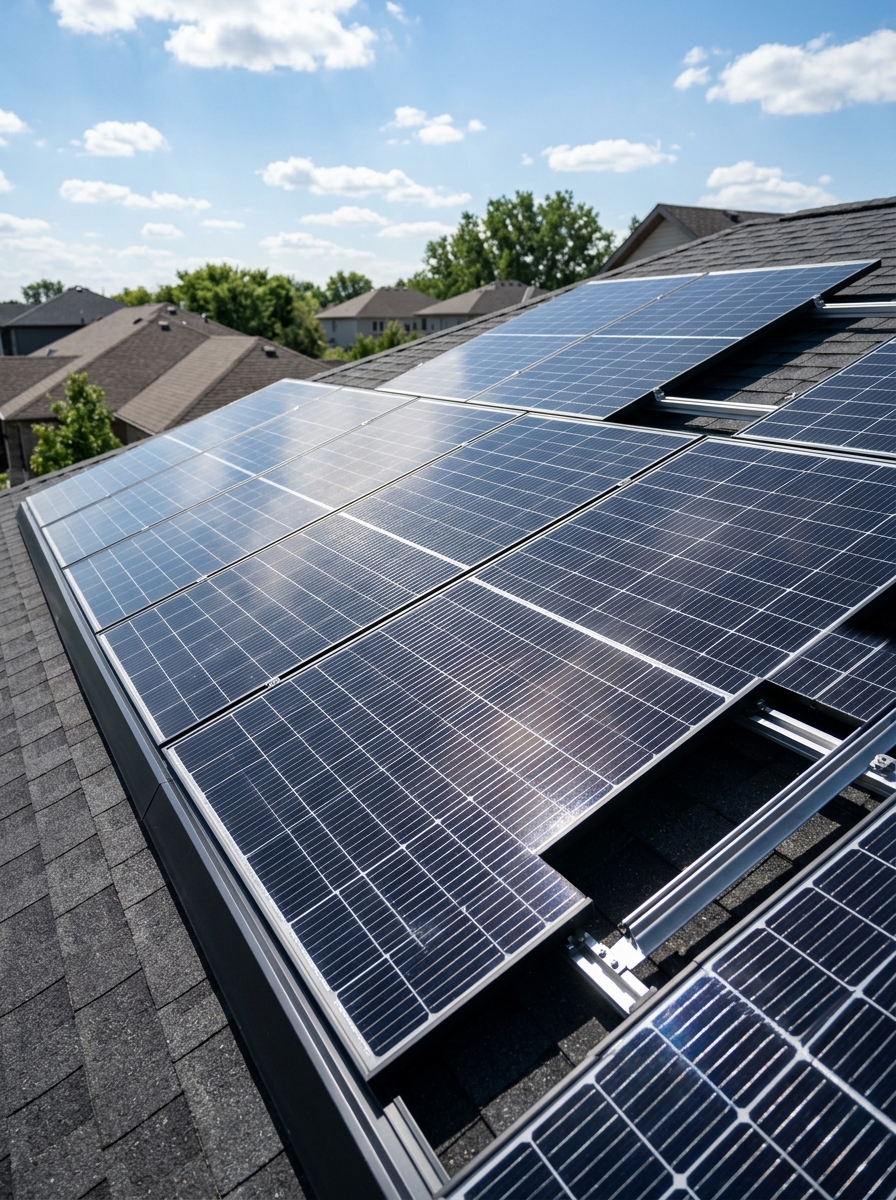
A typical rooftop solar project may include solar panels, an inverter, mounting structures, cables, electrical protection equipment, installation and commissioning. Battery storage, if required, adds to the investment.
Depending on the lender and project, financing may be available through:
- Dedicated rooftop solar loans
- Home improvement or composite home loans
- Personal loans
- Business and equipment loans
- Solar-specific EMI plans
- Leasing and power purchase agreements (PPAs)
The borrower generally repays a loan through scheduled instalments over an agreed tenure. The lender may assess income, credit history, existing liabilities, project cost and repayment capacity before approving the application.
Before choosing an option, compare the complete borrowing cost, including interest and fees, rather than focusing only on the advertised monthly EMI.
How Solar Financing Helps Manage Upfront Costs
Consider a homeowner planning a rooftop solar installation costing ₹2,00,000. Paying the entire amount upfront may not suit the household’s current budget. Financing can spread the expense across a repayment period, allowing the homeowner to retain some savings for other needs.
Once the system is installed and operational, it may reduce electricity purchases from the grid. Those savings can help offset part of the loan repayment, depending on the system’s generation, household consumption and electricity tariff.
However, solar savings should not automatically be assumed to cover the full EMI. Loan interest, weather, shading, maintenance, electricity usage and the actual system cost all influence the financial outcome.
Businesses can use the same principle to preserve working capital while investing in rooftop solar. The decision should be based on a realistic financial assessment rather than an assumption that the system will immediately pay for itself.
The Role of Government Support in Solar Financing
Government support can reduce the effective cost of eligible residential rooftop solar projects. Under the PM Surya Ghar: Muft Bijli Yojana, eligible households may receive central financial assistance according to the scheme’s applicable rules.
In July 2026, the Ministry of New and Renewable Energy reported provisions for eligible residential consumers that included collateral-free loans through nationalised banks at a concessional interest rate linked to the repo rate, with a stated tenure of up to 10 years. The applicable rate and eligibility conditions must be confirmed with the participating bank because scheme provisions and financial terms can change.
A subsidy and a loan serve different purposes. A subsidy may reduce the effective project cost, while a loan provides funds that must be repaid. Customers should confirm how the subsidy is applied, whether it affects the eligible loan amount, and what happens if installation or verification is delayed.
Types of Solar Financing Options Available
Residential Solar Loans and EMI Plans
Residential solar loans are designed to help eligible individuals fund rooftop solar installations. Depending on the lender, they may be offered as standalone solar loans, home-loan-linked financing or other eligible retail credit products.
Some designated schemes may provide concessional terms, while ordinary personal or home improvement loans follow the lender’s own pricing and eligibility criteria.
EMI, or Equated Monthly Instalment, is the scheduled amount a borrower pays towards a loan. The EMI usually depends on the principal, interest rate and repayment tenure.
For example, financing ₹1,50,000 at an illustrative interest rate of 9% per year over five years would result in an EMI of approximately ₹3,114, excluding any fees or additional charges. This is only a calculation example, not a quoted offer from a bank.
A longer tenure can reduce the monthly payment but may increase total interest. A shorter tenure generally raises the EMI while potentially lowering the total borrowing cost. Choose a repayment schedule that remains affordable even when solar savings are lower than expected.
Commercial Solar Loans and Business Financing
Businesses can explore commercial solar loans, equipment financing, term loans and other structured credit arrangements. These options may suit offices, factories, warehouses, hospitals, schools and other properties with suitable rooftops or energy requirements.
Lenders may evaluate business turnover, cash flow, financial statements, credit history, project feasibility and the proposed repayment structure. Larger projects may require technical assessments and more extensive financial documentation.
Before selecting a loan, businesses should estimate expected solar generation, electricity savings, maintenance costs and the system’s useful operating life. They should also compare the financing cost with other potential uses of their capital.
For organisations planning a rooftop installation, commercial and institutional solar solutions can help inform the technical scope of a project before its financing structure is finalised.
Leasing, PPAs and Third-Party Ownership
A conventional loan usually allows the customer to purchase and own the solar system, subject to the financing agreement. However, ownership is not the only available model.
Under a lease arrangement, the customer generally pays to use the solar equipment according to the contract. Under a power purchase agreement, a customer typically purchases the electricity generated by a system owned or financed by a third party. Exact responsibilities vary by contract and jurisdiction.
These models can reduce the customer’s initial capital requirement, but they may involve long-term contractual commitments, payment escalations, minimum terms or asset ownership restrictions.
Before signing, review who owns the system, who maintains it, how electricity is priced, what happens when the property is sold, and how the agreement ends. Compare the full contractual cost with the cost of owning a system through a loan.
How to Apply for Solar Financing and Calculate the Investment
Check Eligibility and Prepare the Required Documents
Solar loan eligibility depends on the financing product. Residential lenders may consider age, income, credit history, repayment capacity, property or rooftop rights and the proposed system cost. Businesses may need to demonstrate financial stability, suitable site access and the project’s ability to meet repayment obligations.
Common documents can include:
- Identity and address proof
- Recent bank statements
- Salary slips or income-tax returns, where applicable
- Electricity bills and property-related documents
- A detailed solar system quotation
- Business registration and financial statements for commercial applicants
- Technical or installation documents requested by the lender
Scheme-linked loans may require additional conditions, such as using an eligible vendor or completing installation and verification through the applicable process. Requirements differ, so confirm the current checklist directly with the lender before applying.
Follow the Solar Loan Application Process
A typical application follows several steps.
Step 1: Assess electricity consumption. Review electricity bills, daytime usage, available rooftop area and future energy requirements.
Step 2: Obtain a detailed quotation. Request a breakdown of system capacity, equipment, installation, warranty and applicable taxes or charges.
Step 3: Compare financing options. Evaluate interest rates, tenure, processing fees, collateral requirements and prepayment conditions.
Step 4: Submit the application. Provide the lender’s required personal, financial and project documents.
Step 5: Complete assessment and approval. The lender reviews creditworthiness and any technical or project requirements applicable to the financing product.
Step 6: Confirm disbursement and installation arrangements. Understand how funds will be released and whether payments go to the applicant, vendor or another party under the agreement.
Step 7: Complete installation and verification. Follow the relevant electrical, grid-connection and scheme procedures.
Do not assume that a loan is approved or a subsidy is guaranteed until the relevant institution confirms the applicable terms.
Calculate EMI, Total Repayment and Solar Savings
The right financing decision depends on both affordability and total cost. A low EMI may appear attractive but can result in more interest over a longer repayment period.
Compare the following for each offer:
- Principal amount and any required down payment
- Interest rate and whether it is fixed or floating
- Repayment tenure and monthly EMI
- Processing fees and other charges
- Prepayment or foreclosure conditions
- Total amount payable over the loan term
Next, estimate the solar system’s financial benefits. Consider annual electricity savings, expected generation, maintenance, equipment replacement and any subsidy for which the project is eligible.
A useful comparison is:
Estimated net benefit = Expected electricity savings + applicable financial assistance − project costs − financing costs − other operating expenses
This is a simplified assessment, not a guaranteed return. A detailed calculation should account for timing, changing electricity tariffs, degradation, taxes and the actual terms of the financing agreement.
Benefits, Risks and Key Considerations Before Choosing Solar Finance
Reduce Upfront Pressure While Protecting Cash Flow
Financing can make solar installation more manageable by spreading the cost across monthly instalments. Homeowners may preserve emergency savings, while businesses can retain working capital for inventory, staff and other operating expenses.
However, borrowing creates a fixed financial obligation. The EMI must still be paid if solar generation is lower than expected, the property uses more electricity than planned, or installation is delayed.
Choose an amount and tenure that fit your budget without relying entirely on projected energy savings. Maintaining a financial buffer can help manage unexpected costs.
Compare Financing Plans Beyond the Advertised EMI
Before accepting an offer, compare the effective borrowing cost and the contract’s conditions. Two lenders may offer different interest rates, fees, loan limits and repayment schedules.
A longer repayment period may provide a lower EMI but increase total interest. A plan with a higher EMI may cost less overall if it carries a shorter tenure and comparable fees. The best option depends on your income, cash flow and financial priorities.
Also check whether the interest rate can change, whether there are penalties for late payments, and whether early repayment is permitted without additional charges.
For commercial projects, consider the effect of the loan on cash flow, debt obligations and other planned investments. For residential projects, ensure the EMI remains affordable alongside regular household expenses.
Assess Long-Term Value and Choose the Right System
Financing terms cannot compensate for a poorly designed solar installation. The system should match electricity consumption, rooftop conditions, equipment quality and the property’s future needs.
Ask for a clear project quotation and understand the expected generation, warranty coverage, maintenance responsibilities and grid-connection requirements. Check whether the financial estimate assumes a subsidy, and verify that the project meets the applicable eligibility conditions.
For homeowners, the objective may be to reduce monthly electricity expenses while keeping the EMI manageable. For businesses, the priorities may include long-term operating-cost control, cash-flow planning and energy resilience.
Solar financing is most useful when the repayment structure and system design work together. A careful comparison of loan offers, project costs and realistic electricity savings can help customers make a more informed investment decision.
Conclusion
Solar financing in India offers homeowners and businesses several ways to manage the upfront cost of adopting solar power. Residential solar loans, EMI plans, commercial financing, leasing and power purchase agreements each provide different benefits and obligations.
Government support may improve affordability for eligible residential projects, but subsidy eligibility, loan terms and application procedures should be verified through the relevant official programme and participating lender.
Before choosing a financing plan, compare interest rates, total repayment, fees, tenure and prepayment conditions. Then assess the solar system’s expected generation and realistic savings to understand whether the investment fits your financial goals.
The right approach is not simply to find the lowest EMI. It is to select a suitable solar system and financing arrangement that remains affordable, provides practical value and supports your long-term energy requirements.