Choosing the right solar system capacity is one of the most important decisions when planning a rooftop solar installation. A system that is too small may not generate enough electricity to meet your household requirements, while an oversized system can increase the initial investment without providing proportional benefits.
A proper solar system size calculation for home should consider your monthly electricity consumption, rooftop space, sunlight availability, appliance usage, and future energy requirements. For example, a small household using around 100–150 units per month may need a different system from a larger family consuming 400–500 units.
In India, residential solar systems commonly range from 1kW to 10kW or more, depending on household consumption and available roof space. The right capacity can help reduce grid electricity dependence and improve long-term energy savings.
This guide explains how to calculate the required solar capacity, compare common system sizes, and choose a suitable rooftop solar system for your home.
Why Choosing the Right Solar System Size Matters
Selecting the correct solar capacity helps you balance electricity generation, installation costs, available rooftop space, and your household’s actual energy needs. Solar panels generate electricity according to their capacity and the amount of sunlight they receive.
A properly sized system can reduce your dependence on grid electricity and help you make better use of your rooftop. However, solar generation varies throughout the year because of weather, seasonal sunlight, shading, and system efficiency.
Therefore, capacity selection should not be based only on the number of appliances you own. Your historical electricity consumption is usually a better starting point.
Impact of Correct Capacity on Electricity Generation
A correctly sized solar system can generate a meaningful portion of your household’s annual electricity requirement.
For example, a 3kW rooftop system may generate significantly more electricity over a year than a 1kW system under similar sunlight conditions. However, actual output depends on location, panel orientation, shading, temperature, inverter performance, and system losses.
A typical residential rooftop system may generate approximately:
- 1kW: Around 3–5 units per day under favourable conditions
- 3kW: Around 9–15 units per day
- 5kW: Around 15–25 units per day
These are broad estimates, not guaranteed outputs. Actual generation can vary considerably between locations and seasons.
The best approach is to compare estimated annual generation with your historical electricity consumption rather than relying only on daily averages.
Problems Caused by Oversized or Undersized Systems
An undersized solar system may not generate enough electricity to meaningfully reduce your grid consumption.
For example, if your household uses 500 units per month but installs a system designed for substantially lower consumption, you may continue purchasing a significant amount of electricity from the grid.
An oversized system can create different challenges.
Potential issues include:
- Higher upfront installation costs
- Greater rooftop space requirements
- Higher inverter capacity requirements
- Additional structural considerations
- Lower financial efficiency if excess generation is not effectively utilised
The ideal system should therefore be based on actual consumption, available space, local solar conditions, and applicable net metering or export regulations.
Matching Solar Capacity With Home Energy Needs
The first step is to understand how much electricity your household actually consumes.
Review your electricity bills from the previous 6–12 months and calculate the average monthly consumption.
For example:
| Average Monthly Consumption | Approximate Daily Consumption |
|---|---|
| 100 units | 3.3 units/day |
| 200 units | 6.7 units/day |
| 300 units | 10 units/day |
| 500 units | 16.7 units/day |
These figures provide a starting point for system sizing.
However, solar generation is not equal to installed capacity multiplied by 24 hours. Solar panels generate electricity only when sunlight is available, and output changes throughout the day.
This is why a professional assessment is useful before finalising the system.
How to Calculate Solar System Size for a Home
Calculating your required solar capacity involves comparing your electricity consumption with the expected energy generation from each kilowatt of installed solar capacity.
A simplified calculation can provide an initial estimate, but the final system design should account for local solar irradiation, system losses, roof orientation, shading, and regulatory requirements.
Understanding Electricity Consumption in Units
Electricity bills in India generally show consumption in units, where one unit is equivalent to one kilowatt-hour (kWh).
Suppose your household consumes 300 units per month.
Your approximate daily consumption would be:
300 ÷ 30 = 10 units per day
You can then compare this requirement with the expected generation from a solar system.
For a simplified example, if 1kW of installed solar capacity generates an average of approximately 4 units per day in your location, the theoretical requirement would be:
10 ÷ 4 = 2.5kW
This suggests that a system around 2.5kW may be worth evaluating.
However, the final selection may be 2kW, 3kW, or another capacity depending on roof conditions, available system sizes, future consumption, and local regulations.
Calculating Required Solar Panel Capacity
A simplified formula for estimating solar capacity is:
Required Solar Capacity = Daily Electricity Consumption ÷ Average Daily Generation per kW
For example:
- Monthly electricity consumption: 300 units
- Average daily consumption: 10 units
- Estimated generation: 4 units per kW per day
10 ÷ 4 = 2.5kW
In this example, a homeowner could evaluate a 2.5kW or 3kW system.
The actual calculation should include a generation margin because solar output can decrease due to cloudy weather, dust, shading, seasonal variations, and equipment losses.
It is also important to remember that a rooftop solar system does not necessarily need to produce 100% of your annual electricity consumption. Your financial objective, available roof area, and grid-export arrangements may influence the final capacity.
Estimating Daily Solar Power Generation
Daily solar generation depends on several variables.
These include:
- Solar irradiation
- Location
- Panel orientation
- Roof tilt
- Shading
- Panel efficiency
- Inverter efficiency
- Temperature
- Dust and maintenance
A simple estimation method is:
Daily Generation = System Capacity × Peak Sun Hours × System Efficiency
For example, assume a 3kW system receives approximately 5 peak sun hours and operates at an estimated overall efficiency of 80%.
3 × 5 × 0.8 = 12 units per day
This is only an illustrative calculation. Actual generation can be higher or lower depending on local conditions.
For accurate planning, homeowners should use site-specific solar assessments rather than relying entirely on generic calculations.
Different Solar System Sizes for Homes
Residential solar systems come in different capacities to suit different electricity consumption levels.
The right option depends on your monthly electricity use, rooftop size, budget, and future requirements.
A small system may suit a low-consumption household, while larger families with air conditioners, water heaters, electric vehicles, or other high-load appliances may need a higher capacity.
1kW Solar System Requirement and Usage
A 1kW solar system is generally suitable for homes with relatively low electricity consumption.
It may be considered for:
- Small households
- Limited appliance usage
- Basic lighting and fans
- Small refrigerators
- Low overall monthly consumption
A 1kW system typically requires around 80–100 square feet of shadow-free rooftop area, although the exact requirement depends on panel dimensions and installation layout.
It may not be sufficient for homes with multiple air conditioners, electric water heaters, induction cooking, or electric vehicle charging.
Homeowners should compare their electricity bills before choosing this capacity.
3kW Solar System Suitability for Families
A 3kW system is a commonly considered option for small to medium-sized households.
It may be suitable for families using:
- Refrigerators
- Fans
- Lighting
- Televisions
- Washing machines
- Computers
- Moderate air-conditioning
A 3kW system may require approximately 240–300 square feet of usable rooftop area, depending on the panel technology and installation arrangement.
However, the actual suitability depends on household consumption.
A family with high air-conditioning usage may need more capacity, while a low-consumption household may find 3kW more than sufficient.
5kW Solar System for Higher Electricity Needs
A 5kW system can be considered by households with higher electricity consumption.
It may be suitable for homes with several energy-intensive appliances, such as:
- Multiple air conditioners
- Electric water heaters
- Large refrigerators
- Water pumps
- Home offices
- Electric cooking appliances
A 5kW installation may require approximately 400–500 square feet of usable rooftop area, depending on the panel size and layout.
Homeowners should also consider whether their electrical connection, inverter configuration, and local grid regulations support the planned capacity.
For high-consumption homes, a detailed load assessment can help determine whether 5kW is sufficient or whether a larger system should be considered.
Factors That Influence Home Solar Capacity
Electricity consumption is important, but it is not the only factor that determines the ideal solar system size.
Two homes with identical monthly electricity bills may require different installation designs because their rooftops, sunlight conditions, and future energy plans differ.
Number of Appliances and Power Usage
The number and type of appliances can significantly affect electricity consumption.
High-energy appliances include:
- Air conditioners
- Electric water heaters
- Electric ovens
- Induction cooktops
- Washing machines
- Water pumps
- Electric vehicle chargers
However, simply counting appliances is not enough.
You should consider how frequently each appliance is used.
For example, an air conditioner used for two hours per day has a different impact from one used for eight hours daily.
Reviewing electricity bills provides a more reliable picture of actual household consumption.
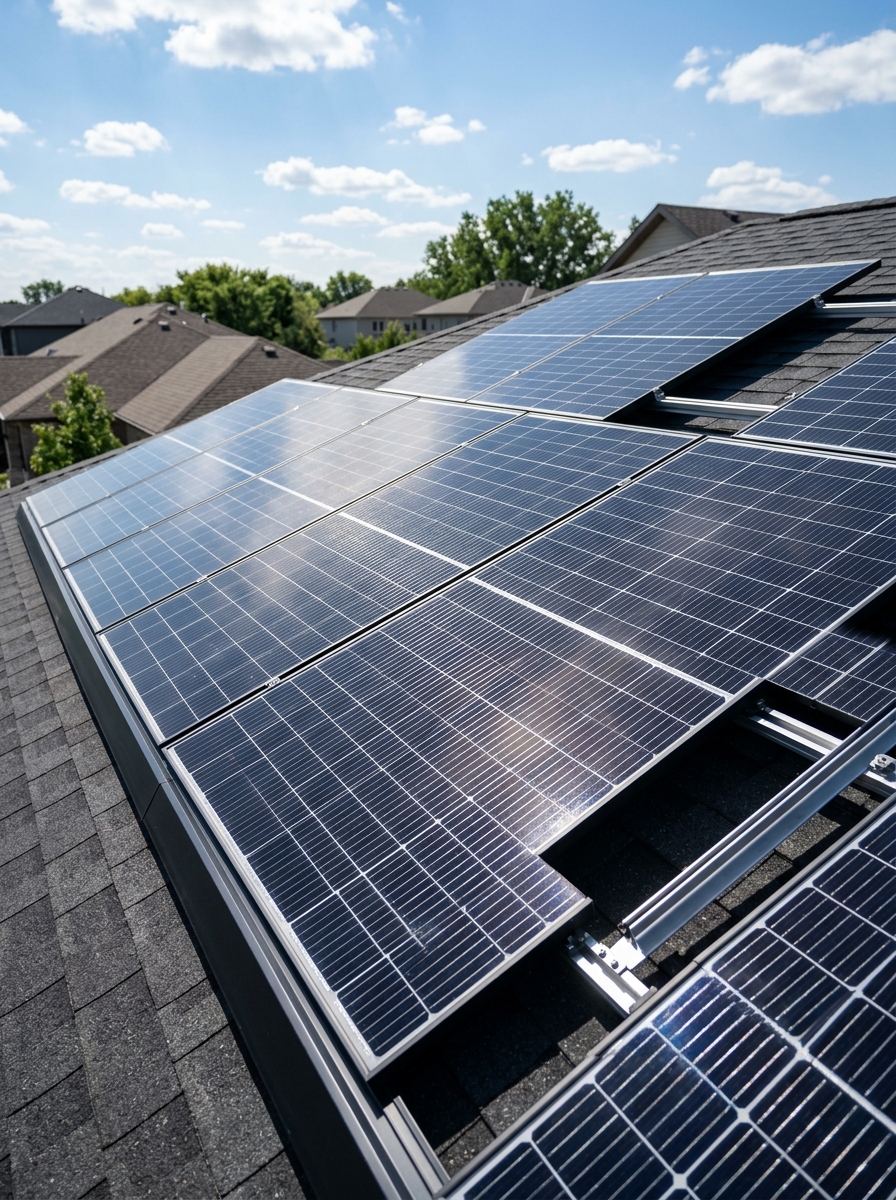
Available Rooftop Area
Rooftop space can limit the maximum solar capacity you can install.
The available area should ideally be:
- Free from significant shading
- Structurally suitable
- Accessible for maintenance
- Properly oriented for solar generation
Water tanks, staircases, chimneys, satellite dishes, and other structures may reduce usable space.
The rooftop should be assessed for shadows throughout the day.
Even partial shading can affect the performance of a solar array, depending on the system design and inverter technology.
A professional site survey can identify the best panel placement and determine how much capacity the roof can accommodate.
Sunlight Availability and Location Factors
Solar generation varies across India.
A rooftop in Rajasthan may receive different solar irradiation from one in Kerala, West Bengal, or a heavily shaded urban area.
Weather patterns, monsoon conditions, local climate, and surrounding buildings can all affect generation.
The direction and tilt of the panels also influence performance.
In India, south-facing rooftops are generally favourable for solar installations, although east- or west-facing systems can also work depending on the roof and energy consumption pattern.
Professional system design should consider local conditions instead of applying the same generation assumptions to every home.
Selecting the Best Solar System for Your Home
Choosing the right solar system requires balancing electricity needs, investment, rooftop conditions, and future plans.
Homeowners should avoid selecting a capacity simply because it is popular or because a neighbour has installed the same size.
The best system is the one that matches your specific requirements.
Comparing Cost and Energy Requirements
The first comparison should be between your electricity consumption and the expected generation of different system capacities.
Create a simple comparison based on:
- Current monthly consumption
- Estimated annual solar generation
- Installation cost
- Available rooftop area
- Expected electricity savings
- Applicable subsidy or incentives
- Net metering availability
For example, a household consuming 150 units per month may not need the same system as a household consuming 500 units.
A solar installer can provide a system proposal showing expected generation and estimated savings.
Review the assumptions behind these estimates before making a decision.
Planning Future Electricity Needs
Your current electricity consumption may not remain constant.
Future energy requirements could increase if you plan to add:
- Air conditioners
- Electric vehicles
- Electric water heaters
- Home appliances
- Additional family members
- Home office equipment
For example, an electric vehicle can significantly increase household electricity demand.
If you plan to install an EV charger within the next few years, it may be worth discussing future capacity requirements during the initial solar design.
However, installing a significantly oversized system today may not always be financially optimal.
The right approach is to evaluate expected future consumption and determine whether the system can be expanded later.
Taking Expert Advice Before Installation
A professional solar assessment can help identify factors that may not be obvious from electricity bills alone.
An expert can evaluate:
- Rooftop area
- Shading
- Panel orientation
- Structural suitability
- Inverter capacity
- Electrical connection
- Expected generation
- Applicable regulations
- Future expansion options
Homeowners should compare quotations from reputable installers rather than choosing based only on the lowest price.
Ask for clear information about equipment specifications, warranties, installation scope, after-sales service, and expected generation.
A reliable installer should explain the assumptions behind the proposed system size.
Conclusion
The right solar system size calculation for home should begin with your actual electricity consumption rather than a standard system size. Reviewing 6–12 months of electricity bills can help you understand your average usage and identify seasonal variations.
From there, you can estimate the required solar capacity based on local solar conditions and expected system generation. A 1kW system may suit low-consumption households, while 3kW and 5kW systems may be more appropriate for families with higher electricity requirements.
However, consumption is only one part of the decision. Rooftop space, shading, panel orientation, local weather, electrical infrastructure, and future energy needs can all affect the final recommendation.
Homeowners should also consider whether they plan to add energy-intensive appliances or an electric vehicle in the future. Planning ahead can help avoid replacing or significantly modifying the system later.
Before installation, compare proposals from qualified solar professionals and review the expected generation, equipment specifications, warranties, installation scope, and after-sales support.
A correctly sized solar system can help you make better use of your rooftop, reduce dependence on grid electricity, and improve the long-term value of your solar investment.
Frequently Asked Questions About Solar System Size Calculation for Home
1. How do I calculate the solar system size for my home?
Review your average monthly electricity consumption, convert it into daily units, and compare it with the estimated daily generation per kW in your location. A professional assessment can then account for shading, roof area, system losses, and future requirements.
2. Is a 3kW solar system enough for a home?
A 3kW system can suit many small and medium-sized households, but suitability depends on electricity consumption and appliance usage. Homes with multiple air conditioners or other high-energy appliances may require a larger system.
3. How much rooftop space is required for a solar system?
The space requirement depends on panel dimensions and installation layout. As a broad estimate, 1kW may require around 80–100 square feet of usable area, while a 5kW system may require approximately 400–500 square feet.
4. Should I install a solar system based on my current or future electricity consumption?
Ideally, consider both. If you plan to add an electric vehicle, air conditioner, or other major appliances, discuss future requirements with your installer before finalising the system capacity.
5. Can an oversized solar system be a problem?
Yes. An oversized system can increase upfront costs and may require additional rooftop space and larger equipment. If excess generation cannot be effectively used or exported, the financial benefits may also be lower than expected.