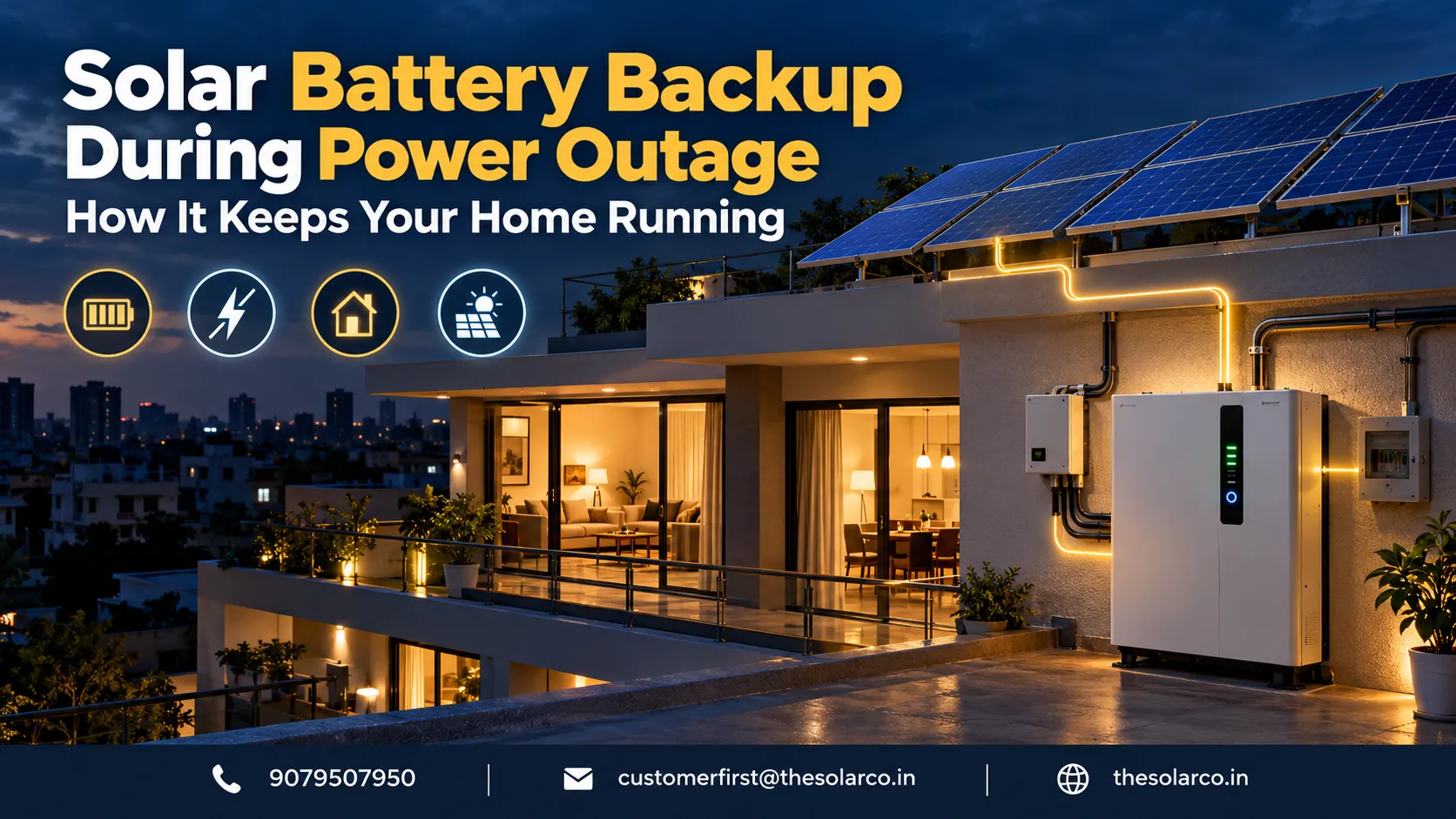
Solar battery backup during power outage can keep essential appliances running when grid electricity suddenly goes off. Unlike a conventional grid-connected solar system, a battery-backed solar setup can store excess solar energy during the day and use that stored electricity when the grid is unavailable.
This capability is becoming increasingly relevant as rooftop solar adoption expands across India. By August 2026, grid-connected rooftop solar had reached 32.59 GW nationally, while more than 50 lakh households were benefiting from the PM Surya Ghar programme. At the same time, India’s projected energy-storage requirement is growing rapidly, making batteries an increasingly important part of modern solar energy systems.
How Solar Battery Backup Works During Power Cuts
A solar battery backup system combines solar panels, a compatible inverter, and battery storage to provide electricity when the utility grid is unavailable.
The exact backup experience depends on the system configuration, battery capacity, inverter output, and the appliances connected to the backup circuit.
Switching From Grid Power to Stored Solar Energy
When the grid supply fails, a properly designed backup system detects the outage and isolates the home from the grid before supplying power to the designated backup loads.
The battery then provides stored DC energy to the inverter. The inverter converts it into AC electricity that household appliances can use.
This transition is managed automatically in compatible systems, so essential devices can continue operating without requiring manual battery switching.
Role of Battery and Inverter During an Outage
The battery stores electrical energy, while the inverter controls how that energy is delivered to household loads.
During an outage, the inverter becomes the central control point. It manages battery discharge, supplies AC power to connected loads, and, depending on the system design, can also use available solar generation to support the loads or recharge the battery.
Modern hybrid inverters can therefore coordinate solar panels, batteries, household loads, and the grid in one system.
Maintaining Essential Home Electricity Supply
A backup system does not necessarily need to power the entire house.
Creating a dedicated essential-load circuit can be more practical. Lights, fans, Wi-Fi equipment, refrigerators, security systems, and selected sockets can be prioritized while high-consumption appliances remain disconnected during an outage.
This approach extends battery runtime and makes the available stored energy more useful.
What Appliances Can Run on Solar Backup?
The appliances you can operate depend on two different measurements: power demand and energy consumption over time.
A battery may have enough stored energy for several hours, but the inverter must also be capable of handling the instantaneous power demand of the connected appliances.
Calculating Backup Power Requirements
Start by listing the appliances you want to operate during a power cut and note their approximate wattage.
For example:
| Appliance | Approx. Power | Priority |
|---|---|---|
| LED lights | 10–15 W each | High |
| Ceiling fan | 50–80 W | High |
| Wi-Fi router | 10–20 W | High |
| Refrigerator | Variable | High |
| Television | 60–150 W | Medium |
| Computer | 100–250 W | Medium |
| Air conditioner | High | Depends on system |
These figures are examples, not fixed consumption values. Actual power requirements vary by model and operating conditions.
To estimate energy consumption, multiply the appliance load by the number of hours it operates.
Energy used = Power × Operating time
For battery sizing, usable battery energy and system losses should also be considered rather than assuming that the entire nameplate battery capacity will always be available to the loads.
Running Lights, Fans and Essential Devices
Lights, fans, routers, refrigerators, security cameras, and other essential electronics are generally easier to support with a correctly sized battery system.
Instead of trying to run every appliance normally, homeowners can prioritize essential loads during an outage.
This creates a practical balance between comfort and backup duration.
Managing High-Power Appliances
Air conditioners, electric geysers, induction cooktops, water heaters, pumps, and other high-power appliances can consume battery energy quickly.
Some also have significant starting or surge requirements.
If these appliances need backup power, the inverter must be sized for their operating and starting characteristics, and the battery must provide sufficient discharge power.
In many homes, it is more efficient to keep high-load appliances outside the backup circuit unless extended backup for them has been specifically designed into the system.
Factors Affecting Solar Backup Duration
There is no single backup time that applies to every solar battery system. Runtime changes according to battery capacity, connected load, battery condition, inverter efficiency, and whether solar energy is available during the outage.
Battery Capacity and Energy Usage
A larger battery stores more energy, but backup duration still depends on how much electricity the home consumes.
For example, using a small number of essential appliances can provide considerably longer backup than running multiple high-power devices simultaneously.
Battery capacity is usually expressed in kWh. However, usable energy can be lower than the nominal capacity because of operating limits, reserve settings, conversion losses, and other system factors.
Load Management During Power Cuts
Load management is one of the simplest ways to extend backup time.
During a long outage, homeowners can:
- Keep only essential lights switched on.
- Reduce unnecessary fan or appliance usage.
- Avoid running high-power heating appliances.
- Delay washing machine or dishwasher cycles.
- Disconnect devices that are not required.
- Use scheduled or priority-based loads where the system supports them.
Smart energy management can make battery storage considerably more useful without immediately increasing battery size.
Solar Charging Availability
Solar panels can continue producing electricity during a daytime outage if the system is specifically designed to operate in backup or islanded mode.
This is an important difference between a standard grid-tied solar system and a properly configured hybrid solar-plus-storage system.
If sunlight is available, solar generation can supply active loads and potentially recharge the battery. At night or during heavy cloud cover, the system may depend primarily on stored energy.
Choosing the Right Backup System for Home
The best backup system is not necessarily the one with the biggest battery. It should match the home’s electricity requirements, outage pattern, available solar generation, and budget.
Understanding Backup Time Requirements
Think about the type of outages you experience.
If outages normally last 30–60 minutes, a smaller backup system may be sufficient for essential loads. If outages regularly last several hours, a larger battery and stronger energy-management strategy may make more sense.
For areas with unpredictable outages, homeowners may also benefit from a system capable of recharging from solar during the day.
Selecting a Suitable Battery Size
Battery sizing should consider:
- Essential load in watts.
- Required backup duration.
- Daily solar generation.
- Usable battery capacity.
- Battery discharge capability.
- Expected future electricity demand.
For example, a home that needs approximately 500 W of essential loads for four hours requires about 2 kWh of usable energy before accounting for system losses and reserve requirements.
The final battery size should therefore be determined through a complete system assessment rather than a simple load calculation.
Matching Inverter and Battery Capacity
Battery capacity and inverter capacity are not the same thing.
A large battery does not automatically mean the system can run high-power appliances. The inverter must be able to deliver the required continuous power and handle appropriate surge requirements.
Battery voltage, maximum charge/discharge current, communication protocol, battery management system, and inverter compatibility should also be checked before installation.
Benefits of Solar Backup During Emergencies
Solar battery storage provides more than convenience during a short power cut. It can become part of a home’s broader energy-security strategy.
Reliable Electricity Availability
A battery-backed solar system can keep essential circuits operating even when grid electricity is unavailable.
This can be especially useful for homes that depend on Wi-Fi, security systems, medical-support equipment, refrigeration, or work-from-home infrastructure.
Protection Against Frequent Power Interruptions
Frequent voltage interruptions and outages can disrupt work, communication, refrigeration, and other household activities.
A properly configured backup system reduces dependence on the immediate availability of grid power for selected loads.
Modern monitoring can also provide information about battery state of charge, solar generation, household consumption, and system alerts, helping homeowners understand how their energy is being used.
Better Energy Security for Homes
Energy storage is becoming a larger part of India’s electricity planning. The Ministry of New and Renewable Energy notes that India’s projected storage requirement is expected to reach 82.37 GWh in 2026–27 and 411.4 GWh by 2031–32, reflecting the growing importance of battery and other storage technologies as renewable generation expands.
For homeowners, this broader shift means solar systems are increasingly moving beyond simple daytime electricity generation. Solar panels plus battery storage can provide a more flexible energy system that generates, stores, and manages electricity according to household needs.
Final Takeaway
Solar battery backup during power outage can keep essential household electricity available by combining solar generation, battery storage, and a suitable hybrid or backup-capable inverter.
The key is proper system design. Battery capacity should match the required backup duration, while inverter capacity should match the connected loads. High-power appliances should be managed carefully, and the system should be designed to safely isolate the home from the grid during an outage.
As India’s rooftop solar market continues to expand and energy storage becomes increasingly important, battery-backed solar is becoming a practical option for homeowners who want greater control over their electricity supply.
For the best results, a professional solar assessment should consider your actual electricity consumption, essential loads, outage duration, rooftop solar generation, battery requirements, and future energy needs before selecting the system.