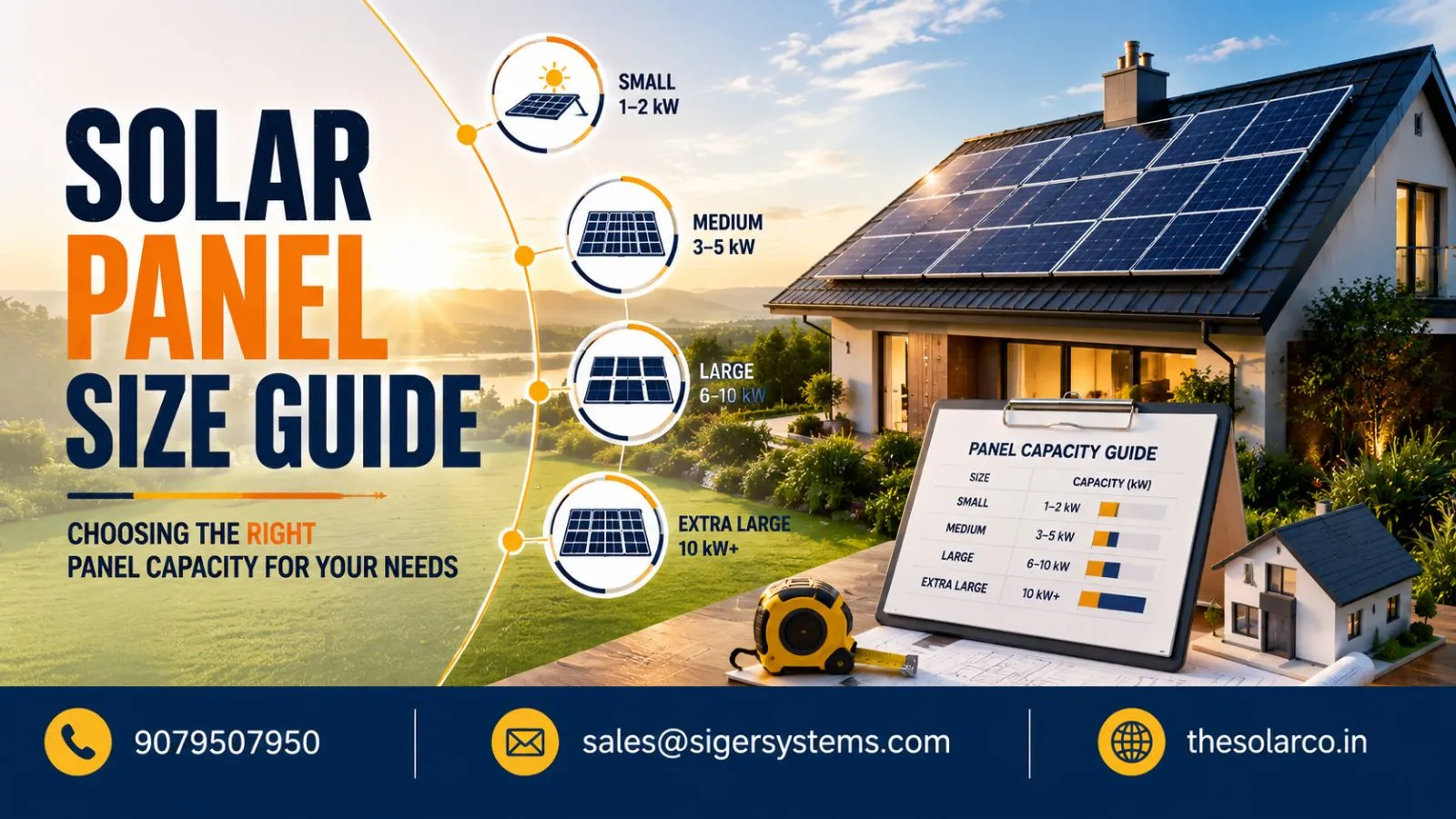
Choosing the right solar panel size is an important step when planning a residential or commercial solar installation. However, solar panel size can refer to two different things: the physical dimensions of an individual panel and its electrical power capacity, measured in watts.
Both factors influence your solar installation. Physical dimensions determine how much rooftop space each panel occupies, while its rated capacity helps determine how many panels are needed to achieve the desired system size.
Modern solar panels are available in different wattages, dimensions and cell technologies. The right choice depends on electricity consumption, available roof space, sunlight exposure, installation conditions, budget and future energy requirements.
This solar panel size guide explains how to compare panel dimensions, calculate panel quantities and select a suitable system for your property.
Understanding Solar Panel Size, Dimensions and Wattage
Physical Size vs. Electrical Power Capacity
Physical panel size refers to the module’s length, width and thickness, usually measured in millimetres or metres. Power capacity refers to its rated electrical output under standard test conditions and is expressed in watts-peak (Wp).
For example, a 500 W panel has a higher rated capacity than a 400 W panel. However, it may also have different physical dimensions, depending on its cell technology and design.
These measurements serve different purposes:
- Physical dimensions: Help determine whether panels fit the available roof area.
- Wattage: Helps calculate the total installed solar capacity.
- Efficiency: Indicates how effectively a panel converts sunlight into electricity relative to its surface area.
- Energy generation: Measures the electricity produced over time, typically in kilowatt-hours (kWh).
A higher-wattage panel does not automatically guarantee better value. Its dimensions, efficiency, cost, compatibility and expected performance should be evaluated together.
Common Solar Panel Dimensions and Wattage Ranges
There is no single standard solar panel size. Dimensions vary by manufacturer, cell configuration, technology and power rating.
As a broad planning reference, many modern rooftop modules fall within the following ranges. These are approximate examples, not specifications for every product.
| Panel capacity | Approximate physical dimensions | Typical consideration |
|---|---|---|
| 300–400 W | Around 1.6–1.8 m × 1.0–1.1 m | Smaller modules or installations with specific layout requirements |
| 400–450 W | Around 1.7–1.9 m × 1.0–1.1 m | Residential rooftops and compact layouts |
| 500–550 W | Around 2.0–2.3 m × 1.1–1.2 m | Higher capacity per module |
| 550–600 W and above | Varies considerably by model | Larger-format modules and suitable commercial or residential installations |
Always check the selected module’s technical datasheet for exact length, width, thickness, weight and mounting requirements. Two panels with similar wattage may not have identical dimensions.
How Wattage and Efficiency Affect Solar Generation
Panel wattage indicates rated power under specified test conditions. It does not mean the panel produces that amount of electricity continuously throughout the day.
Actual generation depends on sunlight availability, orientation, tilt, temperature, shading, equipment efficiency and other system losses.
For example, a 500 W panel can produce different amounts of electricity on a clear day and a heavily overcast day. Annual generation also varies by location and installation design.
Higher-efficiency panels can be useful when rooftop space is limited because they may deliver more rated power per square metre. However, buyers should compare total system cost, product quality, warranties and expected generation rather than choosing a panel based on efficiency alone.
Choosing Solar Panel Capacity for Your Home or Business
Estimating Panel Requirements From Electricity Consumption
The right solar system capacity depends on how much electricity the property consumes and how much of that demand the owner intends to offset.
For homes, review several months of electricity bills to understand monthly consumption and seasonal changes. Also consider high-energy appliances such as air conditioners, electric water heaters, pumps and electric vehicle chargers.
For businesses, examine operating hours, machinery loads, cooling requirements, electricity demand patterns and available rooftop space. A commercial installation may require a more detailed engineering assessment.
Electricity consumption is a useful starting point, but the final system capacity should also account for local solar conditions, applicable grid arrangements, inverter selection and installation constraints.
How Many Solar Panels Are Needed for a 5 kW System?
Panel quantity can be estimated by dividing the desired solar capacity by the rated capacity of each panel.
Formula:
Number of panels = Desired system capacity in watts ÷ Panel wattage
For a 5 kW system, the approximate comparison is:
| Individual panel rating | Approximate panel quantity | Combined panel capacity |
|---|---|---|
| 400 W | 13 | 5.2 kW |
| 450 W | 12 | 5.4 kW |
| 500 W | 10 | 5.0 kW |
| 550 W | 10 | 5.5 kW |
These examples illustrate panel arithmetic, not a final installation design. When the calculation produces a fraction, the number of panels must be rounded appropriately, and the resulting array capacity may exceed the original target. The inverter, electrical design, roof layout and applicable requirements must accommodate the selected configuration.
Residential vs. Commercial Solar Panel Sizing
Residential installations often need to balance electricity requirements with limited roof space, water tanks, staircases, parapet walls and maintenance access.
Commercial and industrial installations may have more available roof area but greater electricity demand and more complex operating requirements. Panel selection may also be influenced by structural loading, mounting systems, inverter configuration and maintenance planning.
For both applications, the objective is to select a suitable combination of panel capacity, physical dimensions and system design rather than simply installing the maximum number of panels that can fit.
Businesses evaluating larger projects can explore solar solutions for commercial and institutional properties to understand the broader considerations involved in planning an installation.
Rooftop Space, Panel Selection and Installation Costs
Calculating Usable Rooftop Area
The total roof area is not necessarily the same as the area available for solar panels. Some sections may be shaded, inaccessible or unsuitable for mounting.
Usable area can be reduced by:
- Water tanks, staircases and rooftop equipment
- Parapet walls and nearby obstructions
- Roof access and maintenance pathways
- Required setbacks and mounting clearances
- Roof orientation, tilt and shading
- Structural or waterproofing limitations
A rough initial estimate can help determine whether a proposed system is feasible, but a measured panel layout is more reliable. The installer should use the actual dimensions of the selected modules and account for mounting arrangements and site-specific requirements.
Higher-wattage panels may reduce the number of modules needed, but they are not always the easiest option for irregular or restricted roof sections.
Balancing Panel Efficiency, Cost and Long-Term Value
The lowest-priced panel is not necessarily the most economical choice over the life of a solar installation. Panel selection should consider the initial cost as well as the system’s expected performance and maintenance requirements.
Compare these factors before making a decision:
- Rated power and conversion efficiency
- Physical dimensions and weight
- Product warranty and performance warranty
- Manufacturer specifications and product quality
- Mounting and installation requirements
- Inverter compatibility
- Expected energy generation
- Total installed cost and maintenance needs
A higher-efficiency module may be attractive for a space-constrained roof, while a different configuration may be more economical when sufficient space is available.
Also distinguish between system capacity in kilowatts and electricity generation in kilowatt-hours. A larger array generally has greater potential output under comparable conditions, but actual production depends on sunlight, shading, equipment and installation quality.
Considering Future Energy Requirements
Solar system planning should account for likely changes in electricity consumption. A household may add air conditioning, an electric vehicle or new appliances, while a business may expand operations or install additional equipment.
Planning for future demand can help avoid choosing a system that becomes inadequate too soon. However, installing excess capacity without considering roof limitations, grid rules, system compatibility and project economics may not be beneficial.
A professional assessment can compare current consumption with anticipated demand and recommend a practical system configuration.
Final Steps for Selecting the Right Solar Panel Size
Use a Practical Panel Selection Checklist
Before finalising a purchase, review the following points:
-
Electricity consumption has been reviewed using historical bills.
-
The desired system capacity has been estimated.
-
Exact panel dimensions and wattage have been checked.
-
Available rooftop space and shading have been assessed.
-
Panel quantity has been calculated and the resulting capacity confirmed.
-
Inverter compatibility and electrical requirements have been reviewed.
-
Warranty terms, product quality and total installation cost have been compared.
-
Future electricity requirements have been considered.
-
A professional site assessment has been completed where needed.
This checklist helps organise the selection process, but the final configuration should be based on the property’s actual conditions and relevant technical requirements.
Why Professional Solar Consultation Matters
A qualified solar installer can assess electricity consumption, roof dimensions, structural condition, sunlight exposure, shading and equipment compatibility before recommending a system.
For properties in Jaipur and elsewhere in India, local solar conditions and the actual rooftop layout should be considered when estimating generation and deciding panel placement. A recommendation based solely on monthly electricity consumption or panel wattage may overlook important installation constraints.
The right solar panel size is ultimately the one that balances rated capacity, physical dimensions, available space, expected energy generation and overall cost.
By evaluating these factors together, homeowners and businesses can choose a solar system that suits their current needs while allowing for practical future planning.