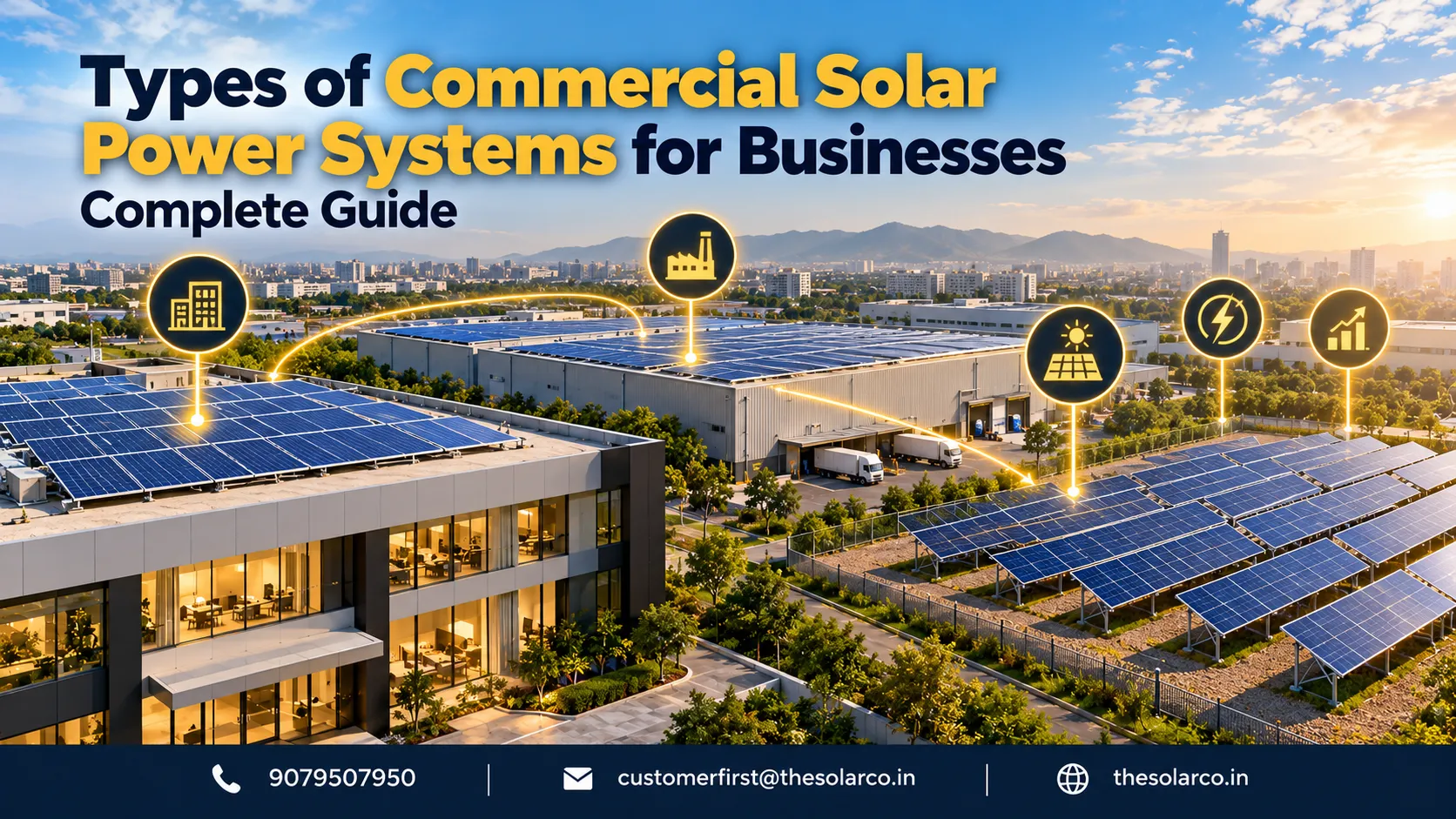
Commercial solar power systems are becoming an important energy strategy for businesses that want to reduce electricity costs, improve energy resilience, and gain more control over long-term power consumption. The right system depends on how a business uses electricity, whether backup power is required, available roof or ground space, and how much energy demand is expected to grow.
India’s solar sector continues to expand rapidly. As of August 2026, the country had 168.04 GW of installed solar capacity, including 32.59 GW of grid-connected rooftop solar. This growth is also changing how businesses approach solar: modern projects increasingly combine efficient PV modules, smart inverters, digital monitoring, and battery storage rather than treating solar as a standalone generation system.
Different Types of Commercial Solar Systems
Commercial solar systems can be designed around three primary operating models: on-grid, off-grid, and hybrid. Each serves a different business requirement.
On-Grid Commercial Solar Systems
An on-grid system is connected to the utility network and is generally designed to offset electricity purchased from the grid.
During daylight hours, solar generation supplies the business’s electrical loads. Depending on the applicable electricity arrangement, surplus generation may be exported to the grid.
This model can work particularly well for offices, retail properties, schools, warehouses, and manufacturing facilities that consume significant electricity during daylight hours.
For businesses with predictable daytime demand, direct solar consumption can improve the value obtained from the installed capacity.
Off-Grid Commercial Solar Systems
An off-grid solar system operates without relying on the utility grid. It normally combines solar generation with battery storage and an inverter capable of managing an independent electrical network.
This configuration can be useful for remote facilities, locations with limited grid availability, or applications where grid-independent operation is essential.
However, off-grid commercial systems require careful energy planning because the battery and solar array must support the site’s demand across different operating conditions, including periods of low solar generation.
Hybrid Solar Systems for Businesses
A hybrid system combines solar generation, grid connectivity, battery storage, and intelligent power management.
During the day, solar energy can supply business loads and charge the battery. Stored energy can then be used when solar production falls, during selected peak periods, or during grid interruptions, depending on system configuration.
For businesses that need both electricity-cost management and backup capability, hybrid solar can offer greater flexibility than a basic grid-connected system.
How Businesses Choose the Right Solar System
There is no universal commercial solar solution. The system should be designed around the business’s electricity profile rather than simply selecting the largest available capacity.
Based on Electricity Requirements
The first step is understanding how much electricity the business consumes and when that consumption occurs.
A facility operating mainly during daylight hours may benefit significantly from direct solar consumption. A business with substantial evening or nighttime demand may need battery storage or another energy-management strategy.
Important factors include:
- Monthly electricity consumption
- Maximum demand
- Daytime versus nighttime load
- Seasonal consumption changes
- Available rooftop or ground area
- Existing electrical infrastructure
- Future electricity requirements
A detailed load assessment helps determine the appropriate solar capacity, inverter configuration, and electrical design.
Based on Backup Power Needs
Not every business requires battery backup.
An office that can tolerate short interruptions may prioritize grid-connected solar, while a data-dependent operation, manufacturing unit, healthcare facility, or cold-storage business may place greater value on continuity.
Where backup is required, the design should identify critical loads first. Instead of powering an entire facility during an outage, a business can create priority circuits for essential equipment.
Battery capacity and inverter output should then be sized according to those loads and the required backup duration.
Based on Budget and Future Expansion
Commercial solar should also be evaluated as a long-term infrastructure investment.
A business may initially install a system based on current electricity demand while keeping space, inverter capacity, electrical infrastructure, or battery integration in mind for future expansion.
Planning for future capacity can prevent unnecessary redesigns when the facility adds machinery, expands operations, or increases electricity consumption.
Components Used in Commercial Solar Systems
A commercial solar installation is more than a collection of photovoltaic modules. Multiple components work together to generate, convert, distribute, monitor, and manage electricity.
Solar Panels and Mounting Structures
Solar modules convert sunlight into DC electricity. Commercial projects can use high-efficiency modules to make better use of limited roof space.
Module selection should consider efficiency, electrical characteristics, environmental conditions, warranty terms, and project requirements. For applicable projects, businesses should also verify current regulatory and procurement requirements. MNRE continues to maintain and update its Approved List of Models and Manufacturers, including updates to module and cell requirements during 2026.
Mounting structures hold the modules at the required orientation and inclination while maintaining mechanical stability. Roof type, wind conditions, structural capacity, maintenance access, and drainage should all be considered during design.
Commercial Solar Inverters
The inverter converts the DC electricity generated by solar modules into AC electricity that the building can use.
Commercial systems may use centralized, string-based, or other inverter configurations depending on project size and design.
Modern inverters can provide detailed operating information and communication capabilities. This makes inverter selection important not only for power conversion but also for system monitoring and energy management.
In 2026, inverter-level generation data has become an increasingly relevant consideration, with MNRE issuing guidelines concerning inverter-level generation data and its storage for rooftop solar systems.
Monitoring and Energy Management Systems
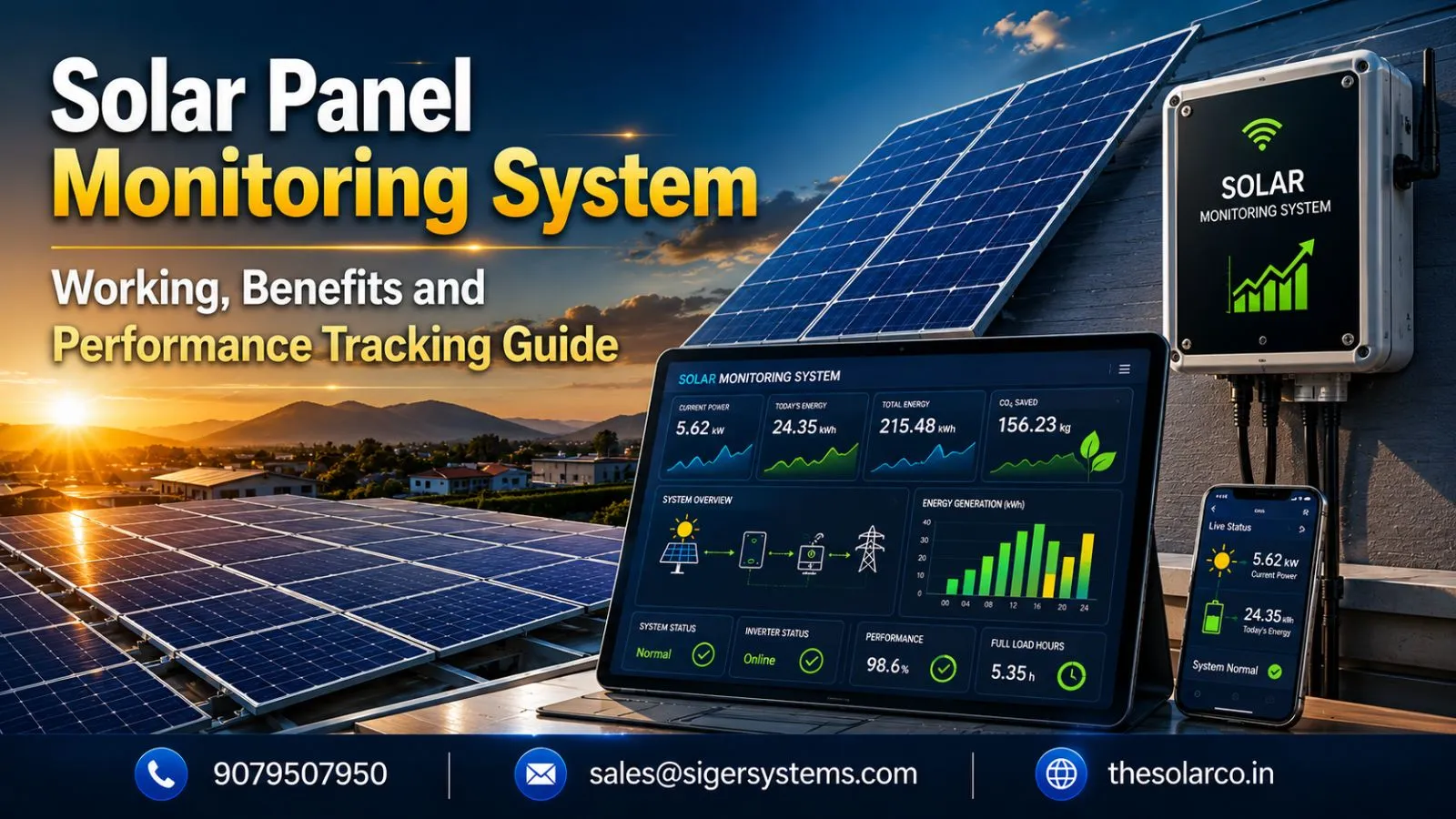
Digital monitoring allows businesses to track solar generation, energy consumption, inverter status, alerts, and historical performance.
Advanced energy management systems can go further by helping businesses understand when electricity is being generated, consumed, stored, or imported from the grid.
For larger facilities, this information can support better operational decisions, identify abnormal system behaviour, and help maintenance teams respond to performance issues faster.
Applications of Different Commercial Solar Systems
The best solar configuration can vary significantly depending on the type of facility and its operating schedule.
Offices and Commercial Buildings
Office buildings typically have substantial daytime electricity demand from lighting, air conditioning, computers, lifts, networking equipment, and other building services.
An on-grid rooftop system can therefore be a natural fit where sufficient roof area is available.
Businesses that require continuity for critical equipment can consider adding battery storage and backup circuits.
Factories and Manufacturing Units
Manufacturing facilities often have larger and more complex electrical loads.
Solar design for a factory should consider machinery schedules, maximum demand, shift patterns, motor loads, process equipment, and future production expansion.
A hybrid system can provide additional flexibility where energy storage, backup, or peak-load management is important.
For some industrial facilities, solar can also be integrated with broader energy-efficiency initiatives rather than treated as a standalone project.
Warehouses and Large Facilities
Warehouses often offer large roof areas that can support substantial solar capacity.
Their electricity profile may include lighting, ventilation, refrigeration, material-handling equipment, office loads, and charging infrastructure.
The large available roof area can make commercial rooftop solar particularly attractive, but structural assessment and careful cable routing remain essential before installation.
Future Trends in Commercial Solar Technology
Commercial solar is moving toward integrated energy systems rather than simple solar generation. Businesses are increasingly looking at how solar, storage, digital monitoring, and flexible loads can work together.
Smart Solar Management Systems
Smart monitoring is becoming a core part of commercial solar operations.
Businesses can use real-time generation and consumption information to identify performance changes, understand energy patterns, and make better decisions about electricity use.
The next stage is more active energy management, where software and connected equipment can help coordinate solar generation, batteries, and selected loads.
Solar Storage Integration
Battery storage is becoming increasingly important as businesses look beyond daytime solar generation.
MNRE cites a projected national energy-storage requirement of 82.37 GWh for 2026–27, rising to 411.4 GWh by 2031–32. This reflects the growing role of storage as renewable generation expands.
For businesses, storage can potentially support backup power, load shifting, renewable-energy utilization, and better management of electricity demand, depending on tariffs and the site’s operating profile.
Advanced Energy Solutions for Businesses
The future of commercial solar is increasingly about combining multiple technologies.
High-efficiency PV modules, smart inverters, battery energy storage, digital monitoring, automated energy management, EV charging, and energy-efficiency measures can work together as a broader commercial energy strategy.
This approach allows businesses to move from simply generating solar electricity to actively managing how electricity is produced, stored, and consumed.
Final Takeaway
Choosing between different commercial solar power systems requires more than comparing solar panel capacity or equipment prices. Businesses should consider electricity consumption patterns, operating hours, backup requirements, available space, future expansion, and the level of energy monitoring they need.
On-grid systems can be effective for businesses with strong daytime consumption, while off-grid systems are designed for locations requiring independent operation. Hybrid systems add battery storage and greater flexibility for businesses seeking backup and advanced energy management.
With India’s solar capacity continuing to grow and energy storage becoming a larger part of the electricity ecosystem, commercial solar projects are evolving into smarter and more integrated energy solutions. A properly designed system can help a business reduce dependence on conventional electricity, improve energy visibility, and prepare its power infrastructure for future needs.