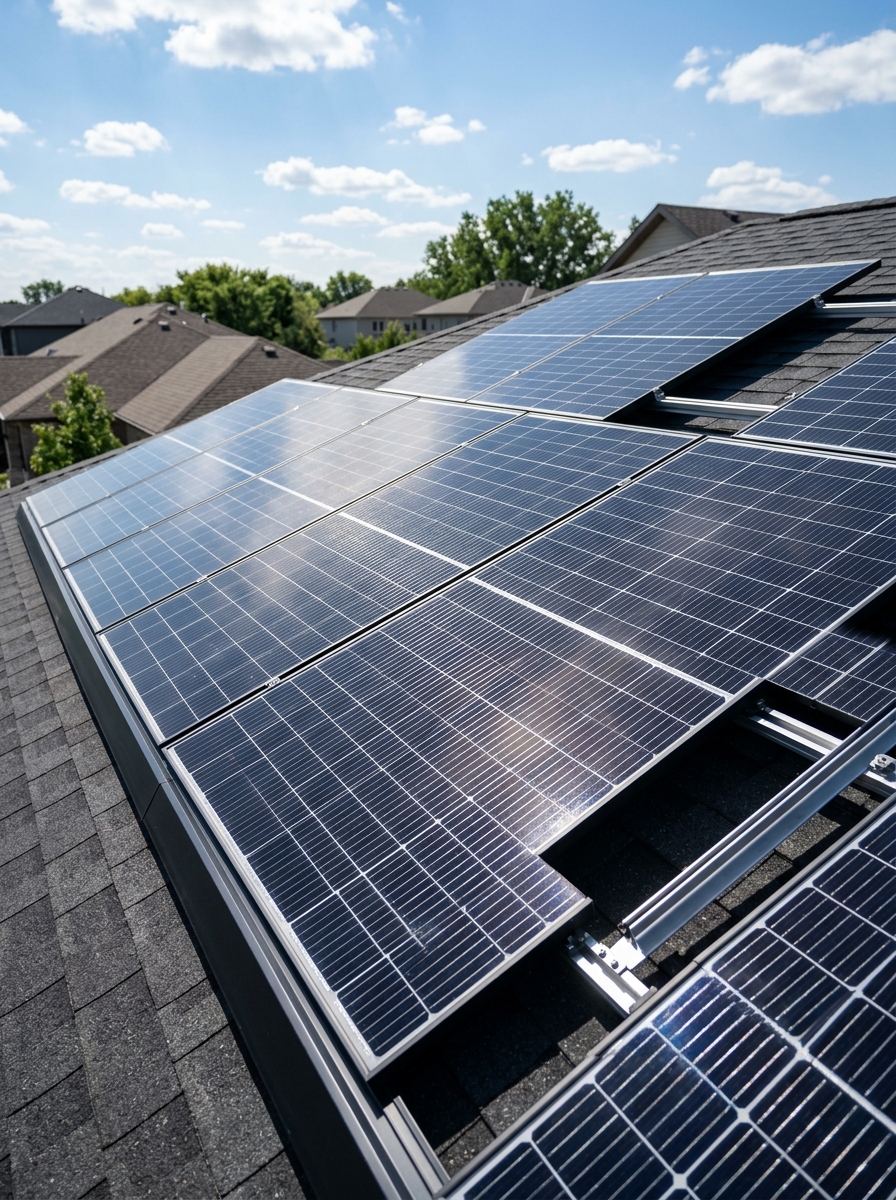

The Central Government’s flagship PM Surya Ghar: Muft Bijli Yojana has revolutionized residential solar adoption across India. Launched with a massive ₹75,021 Crore budget allocation, the scheme targets installation of rooftop solar systems on 1 Crore households by 2027. Homeowners installing rooftop solar systems up to 3kW are eligible for direct cash financial assistance transferred straight into their savings bank accounts — making solar energy accessible to every Indian family regardless of income level.
 1. Government Subsidy Financial Structure
The central subsidy under PM Surya Ghar is structured in a clear tiered format based on the installed system capacity (measured in kilowatts). This structure is designed to encourage maximum adoption among middle-class homeowners who consume between 150–300 units of electricity per month. The subsidy amount is credited directly into the homeowner’s bank account via Direct Benefit Transfer (DBT) after successful system commissioning and net meter installation.
 1 kW System: ₹30,000 direct bank transfer credit — ideal for small homes consuming up to 150 units/month
- 2 kW System: ₹60,000 direct bank transfer credit — suitable for medium households with 150–300 units/month consumption
- 3 kW to 10 kW System: Flat ₹78,000 maximum financial assistance — best value for families with higher consumption or future EV charging needs
- Additional State Subsidies: Many states like Gujarat, Maharashtra, and Rajasthan offer additional state-level subsidies ranging from ₹10,000 to ₹20,000 on top of the central benefit
 2. Step-by-Step Portal Registration Workflow
The entire subsidy application and claim process is 100% digital — no physical paperwork, no government office visits. Everything is handled through the National Portal at pmsuryaghar.gov.in. Here is the complete step-by-step process from registration to subsidy credit:
- Step 1 — Portal Registration: Visit pmsuryaghar.gov.in and register using your state DISCOM name and Electricity Consumer Account Number. You will receive an OTP on your registered mobile number for verification.
- Step 2 — Select Empaneled Vendor: Choose The Solar Co. as your authorized government-empaneled solar installation vendor. Our team will schedule a free rooftop site survey within 48 hours of your registration.
- Step 3 — DISCOM Technical Feasibility: Your local DISCOM (electricity board) engineers will visit your premises to verify rooftop structural integrity, assess shadow-free area availability, and check the existing distribution transformer capacity.
- Step 4 — Installation & Commissioning: After receiving DISCOM approval, our certified engineers install the complete solar system including panels, inverter, AC/DC wiring, earthing, and lightning protection within 3–5 working days.
- Step 5 — Net Meter Installation: DISCOM installs the bi-directional net meter (usually within 15–20 days of commissioning). This meter records both electricity imported from the grid and exported surplus solar power.
- Step 6 — Subsidy Credit: Once the net meter is activated and the commissioning report is uploaded, the central subsidy amount is credited directly to your Aadhaar-linked bank account within 30 working days via DBT.
 3. Eligibility Criteria & Required Documents
The PM Surya Ghar scheme is open to all Indian households with a valid electricity connection. However, there are specific eligibility criteria that must be met to qualify for the central subsidy. Understanding these criteria before applying will save time and ensure a smooth approval process.
- Residential Property: The applicant must own the residential property where the solar system will be installed. Rented properties are not eligible for subsidy claims.
- Active Electricity Connection: A valid, active electricity connection from the local DISCOM is mandatory. The consumer account must be in the applicant’s name.
- No Prior Solar Installation: The household should not have previously availed any central or state solar subsidy. This is a one-time benefit per household.
- Shadow-Free Roof Area: Minimum 100 sq. ft. of shadow-free roof area is required for a 1kW system. For 3kW, approximately 300 sq. ft. is needed.
Documents Required: Aadhaar Card, Electricity Bill (latest 3 months), Bank Passbook (first page with account details), Passport-size photograph, and Roof ownership proof (property tax receipt or registry copy).
 4. Financial Savings & ROI Analysis
One of the most compelling reasons to go solar under the PM Surya Ghar scheme is the exceptional return on investment. When you factor in the central subsidy, the effective cost of a solar system drops dramatically — making it one of the best financial decisions a homeowner can make. Let’s break down the real numbers for a typical 3kW residential solar installation:
3kW System — Cost & Savings Breakdown
After the payback period, the electricity your solar system generates is essentially free for the next 22+ years (solar panels come with a 25-year performance warranty). Over the entire lifetime of the system, a homeowner saves approximately ₹8 to ₹10 Lakhs in electricity costs — making this one of the safest and most rewarding investments available to Indian families today.
 5. Common Mistakes to Avoid During Application
Many homeowners face delays or rejections in their subsidy claims due to simple errors that can be easily avoided. Based on our experience processing thousands of applications, here are the most common pitfalls and how to avoid them:
- Aadhaar-Bank Mismatch: Ensure your Aadhaar number is linked to the same bank account you provide in the application. Mismatched details will cause DBT failure and subsidy delay of 60–90 days.
- Choosing Non-Empaneled Vendors: Only MNRE-empaneled solar installers like The Solar Co. are authorized for subsidy installations. Using a non-empaneled vendor will result in zero subsidy credit, even if the system is installed properly.
- Incorrect Consumer Number: Double-check your DISCOM electricity consumer account number before submitting. An incorrect number will cause the application to be rejected at the DISCOM verification stage.
- Skipping Net Meter Installation: The subsidy is only released after the bi-directional net meter is installed and activated by DISCOM. Do not assume the subsidy will come after panel installation alone — the net meter commissioning report is the final trigger.
- Not Uploading Commissioning Photos: After installation, clear photographs of the installed system (panels on roof, inverter, meter, and module serial numbers) must be uploaded to the portal. Missing photos will hold up the inspection process.
6. Why Choose The Solar Co. for Your Installation?
As a government-empaneled solar installer with over 5,000+ successful residential installations, The Solar Co. offers a complete end-to-end solution — from initial rooftop survey to subsidy disbursal. Here’s what sets us apart:
- Free Site Survey: Our engineers visit your home within 48 hours to assess roof condition, shadow analysis, and optimal panel placement — completely free of charge.
- Complete Paperwork Handling: We manage the entire DISCOM application, technical feasibility, net metering approval, and subsidy claim process on your behalf. Zero paperwork for you.
- Premium Tier-1 Equipment: We use only BIS-certified Tier-1 solar panels (Tata, Adani, Waaree) and MNRE-approved inverters with 25-year performance warranty.
- 5-Year Comprehensive AMC: Post-installation, we provide 5 years of free annual maintenance including panel cleaning, inverter health check, and generation monitoring.
- Guaranteed Subsidy Processing: Our dedicated subsidy team ensures your ₹78,000 subsidy is credited within 30 days of net meter activation — or we follow up with DISCOM on your behalf.
Conclusion
Installing rooftop solar under PM Surya Ghar is not just an environmental choice — it's a smart financial decision that delivers guaranteed returns. With up to ₹78,000 in central subsidy, additional state incentives, and monthly savings of ₹2,800–₹3,500, your solar investment pays for itself in under 3 years. After that, you enjoy 22+ years of virtually free electricity.
The Solar Co. makes the entire journey seamless — from free site survey to installation, DISCOM approvals, net metering, and subsidy processing. Join the solar revolution today and take the first step towards energy independence. Book your free site assessment now and let our experts design the perfect solar solution for your home.