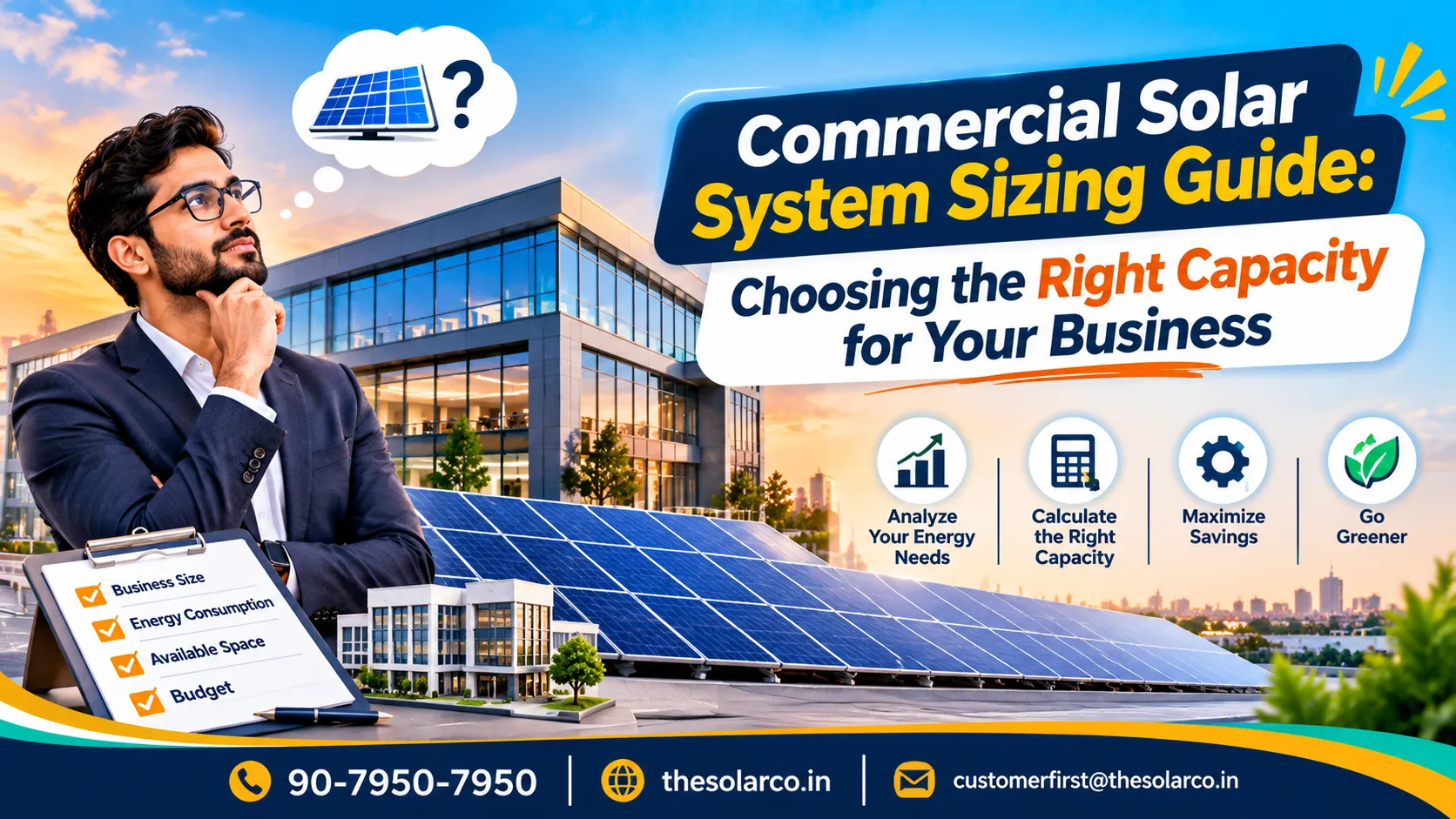
Choosing the right solar capacity is an important decision for businesses planning to reduce electricity expenses and improve energy efficiency. Commercial solar system sizing helps determine how much solar power a business needs based on electricity consumption, available rooftop space, operating hours, and future energy requirements. An appropriately sized system can support daily operations, reduce dependence on grid electricity, and improve the financial value of a solar investment. However, selecting capacity without analysing actual energy usage can lead to unnecessary expenses or insufficient generation. Understanding the sizing process helps business owners make informed decisions before investing in a commercial rooftop solar installation.
Why Solar System Size Matters for Commercial Buildings
Commercial properties generally consume more electricity than residential buildings because they operate multiple electrical systems, machinery, lighting arrangements, and equipment throughout the day. Therefore, selecting an appropriate solar capacity requires a detailed understanding of the property’s electricity requirements.
Impact of Correct System Sizing on Energy Generation
The capacity of a solar installation directly influences how much electricity it can generate under suitable sunlight conditions. A correctly sized system helps businesses utilize available rooftop space efficiently while matching solar production with their electricity consumption.
For example, an office operating primarily during daylight hours may consume a significant portion of its solar-generated electricity directly. A manufacturing facility with continuous operations may have different requirements because its electricity demand can remain high throughout the day and night.
Proper sizing considers several factors:
- Daily and monthly electricity consumption.
- Available sunlight and local weather conditions.
- Solar panel orientation and installation angle.
- Roof shading and surrounding structures.
- Inverter capacity and system configuration.
- Electricity usage during solar generation hours.
These factors help estimate realistic generation rather than relying only on the total capacity mentioned in a solar quotation.
Problems Caused by Oversized or Undersized Systems
An oversized solar installation may generate more electricity than a business can consume during operating hours. Although surplus electricity may be exported under applicable grid policies, the financial benefit depends on approved export arrangements and compensation rates.
Installing unnecessary capacity can also increase the initial investment without delivering proportional savings.
An undersized system creates a different problem. It may generate less electricity than the business requires, leaving the organization dependent on grid power for a larger portion of its consumption.
Common sizing mistakes include:
- Selecting capacity without reviewing electricity bills.
- Ignoring seasonal changes in consumption.
- Underestimating machinery and equipment loads.
- Overlooking available rooftop installation space.
- Ignoring inverter and grid connection limitations.
- Failing to consider future business expansion.
A balanced design helps avoid unnecessary equipment costs while supporting the property’s actual energy requirements.
Importance of Planning Before Installation
Commercial solar planning should begin before selecting panels, inverters, or installation contractors. Businesses should first understand their energy consumption patterns and identify the objectives of their solar investment.
Reviewing electricity bills from the previous twelve months provides a useful starting point. It helps identify seasonal demand changes, monthly consumption patterns, and possible opportunities for reducing electricity expenses.
A professional site assessment should also examine roof condition, structural suitability, electrical infrastructure, shading, and available installation area.
Businesses should evaluate grid connectivity, applicable electricity regulations, export arrangements, and any required approvals. Proper planning helps create a technically suitable system with realistic generation expectations and a clear investment strategy.
Factors That Decide Commercial Solar System Size
The appropriate capacity of a commercial installation depends on more than the size of the building. Electricity demand, available rooftop area, and the timing of energy consumption all influence the final system design.
Business Electricity Consumption Analysis
Electricity consumption is one of the most important factors when calculating solar capacity. Businesses should examine their monthly electricity bills and identify their average daily consumption in kilowatt-hours (kWh).
For example, a commercial property consuming 9,000 units of electricity monthly uses approximately 300 units per day when calculated over a 30-day period.
However, average consumption alone does not provide a complete picture. Businesses should also examine peak demand, operating schedules, and the types of equipment responsible for electricity usage.
Important information to collect includes:
- Monthly electricity consumption in kWh.
- Maximum sanctioned electrical load.
- Peak demand and connected load.
- Daytime and nighttime electricity usage.
- Seasonal variations in energy requirements.
- Planned expansion or additional equipment.
This information allows solar professionals to estimate how much electricity can realistically be supplied through a rooftop installation.
Available Rooftop Area and Solar Potential
Available roof space determines how many solar panels can be installed. However, the entire roof area cannot always be used because certain sections may be unsuitable due to shading, structural limitations, access pathways, or existing equipment.
The solar potential of a commercial rooftop also depends on its orientation, tilt, surrounding buildings, and exposure to sunlight.
Businesses should consider the following factors during a site survey:
Usable rooftop area: Identify sections suitable for panel mounting while maintaining sufficient access for maintenance.
Shading conditions: Nearby buildings, trees, water tanks, and other structures can reduce solar generation.
Structural strength: The roof should safely support the additional weight of panels and mounting structures.
Panel arrangement: Installation spacing should allow appropriate positioning and reduce unnecessary shading between rows.
Electrical infrastructure: Cable routes and inverter locations should be considered during layout planning.
In Rajasthan, commercial rooftops can offer strong opportunities for solar generation because of favourable sunlight conditions. Nevertheless, actual output must be calculated using project location, seasonal weather, and installation-specific details.
Energy Requirements During Working Hours
The timing of electricity consumption is particularly important for commercial solar projects. Solar panels generally generate electricity during daylight hours, with output changing according to sunlight intensity and weather conditions.
Businesses that operate mainly during the day can directly utilize a larger portion of their solar generation.
For example, offices, educational institutions, retail stores, and manufacturing facilities with daytime operations may benefit from matching their electricity demand with available solar production.
Businesses operating at night may require grid electricity or battery storage to meet their remaining demand.
Understanding operating schedules helps determine whether a grid-connected system, battery-supported arrangement, or another configuration is appropriate.
It also helps businesses evaluate the financial value of solar electricity instead of focusing only on the maximum possible installed capacity.
How to Calculate Commercial Solar Capacity for Businesses
Calculating the required capacity involves converting electricity consumption into an estimated solar generation requirement. A practical calculation should consider local generation conditions, system losses, and the property’s electricity usage patterns.
Understanding Commercial Energy Load
Commercial energy load refers to the electricity required to operate equipment, machinery, lighting, cooling systems, and other electrical infrastructure.
A business may have different energy requirements throughout the day. For example, a manufacturing facility may experience higher electricity consumption during production hours, while an office may have increased demand when air conditioning and computer systems operate simultaneously.
Businesses should distinguish between connected load, maximum demand, and actual energy consumption.
Connected load represents the combined rated power of installed electrical equipment. Maximum demand indicates the highest power requirement recorded during a particular period. Energy consumption measures the total electricity used over time.
These measurements are important because solar capacity is generally planned around energy requirements and available generation, while inverter selection must also consider electrical power demand.
Estimating Required kW Capacity
A basic estimation method uses average daily electricity consumption and expected daily solar generation per installed kilowatt.
The formula is:
Required Solar Capacity (kW) = Daily Electricity Consumption (kWh) ÷ Expected Daily Generation per kW (kWh)
For example, assume a business consumes 300 kWh of electricity daily and the estimated solar generation is 4.5 kWh per installed kW per day.
The calculation becomes:
300 ÷ 4.5 = 66.67 kW.
Therefore, approximately 67 kW of solar capacity may be considered as an initial estimate for generating a similar amount of daily electricity under the assumed conditions.
This is only an illustrative calculation. Actual system sizing must account for seasonal generation, system losses, usable roof area, inverter limitations, and grid connection conditions.
Businesses should also decide whether their objective is to offset total annual consumption or supply a specific percentage of their electricity requirements.
Calculating Expected Power Generation
Expected generation depends on installed capacity, sunlight availability, panel orientation, temperature, shading, and system efficiency.
A simplified calculation is:
Daily Solar Generation = Installed Capacity × Daily Generation per kW
For example, a 50 kW installation generating an estimated 4.5 units per kW daily may produce approximately 225 kWh per day.
Monthly generation can be estimated by multiplying expected daily output by the number of days in the month.
However, generation will not remain identical throughout the year. Monsoon weather, winter conditions, summer temperatures, dust accumulation, and maintenance requirements can influence actual performance.
Professional solar feasibility studies generally use location-specific solar data and system design assumptions to estimate annual electricity production more accurately.
Solar System Size Based on Business Types and Benefits of Proper Planning
Different commercial properties have different electricity requirements, roof layouts, and operating schedules. Therefore, solar capacity should be selected according to the business’s actual usage instead of applying the same configuration to every building.
Offices and Commercial Buildings
Offices generally consume electricity through computers, lighting, air conditioning, lifts, networking equipment, and other building systems.
Many office buildings operate primarily during daylight hours, which can create a suitable opportunity for using rooftop solar electricity directly.
A suitable installation should consider the building’s monthly consumption, air-conditioning requirements, roof area, and available electrical infrastructure.
Shopping complexes, hotels, hospitals, and retail buildings may require more detailed assessments because their operating hours and electricity loads can differ significantly.
For these properties, commercial solar solutions can help reduce grid electricity consumption while supporting long-term energy planning.
Factories and Industrial Facilities
Factories and industrial facilities often have higher electrical demand because they operate machinery, production lines, motors, compressors, and cooling systems.
Their solar capacity should be determined through detailed load analysis and engineering assessment.
Industrial projects may require three-phase electrical arrangements, larger inverter configurations, appropriate protection equipment, and careful integration with existing infrastructure.
Businesses should also examine whether their electricity demand continues after sunset. If operations run continuously, solar generation may offset daytime consumption while grid electricity or appropriately designed storage supports other operating periods.
A professional assessment helps determine the most practical system configuration according to production requirements and available installation space.
Warehouses and Large Spaces
Warehouses and distribution centres often have extensive rooftop areas that may be suitable for solar installations.
Their electricity requirements generally come from lighting, ventilation, material-handling equipment, refrigeration, and administrative operations.
Cold storage facilities may have particularly significant electricity consumption because refrigeration systems can operate throughout the day and night.
For such buildings, solar planning should consider roof structure, shading from surrounding objects, equipment placement, and electrical demand patterns.
Better Investment Decisions and Improved System Performance
Proper commercial solar planning helps businesses make more informed financial decisions. By matching installed capacity with electricity consumption, organizations can evaluate expected generation, potential electricity savings, and investment requirements more realistically.
A professionally designed installation can also improve operational reliability through appropriate panel placement, inverter selection, cable sizing, and electrical protection.
Businesses should evaluate project costs, available financing, applicable subsidies or incentives, maintenance requirements, and electricity tariff structures before making an investment decision.
The Solar Co. provides residential, commercial, and institutional solar solutions, including project planning, system design, and installation support. Businesses exploring commercial and institutional solar installations can assess suitable configurations according to their electricity requirements and available infrastructure.
Ultimately, the right commercial solar capacity is determined by energy consumption, rooftop potential, operating schedules, and future business needs. Careful planning helps organizations avoid unnecessary investment, improve solar energy utilization, and move towards more efficient long-term electricity management.