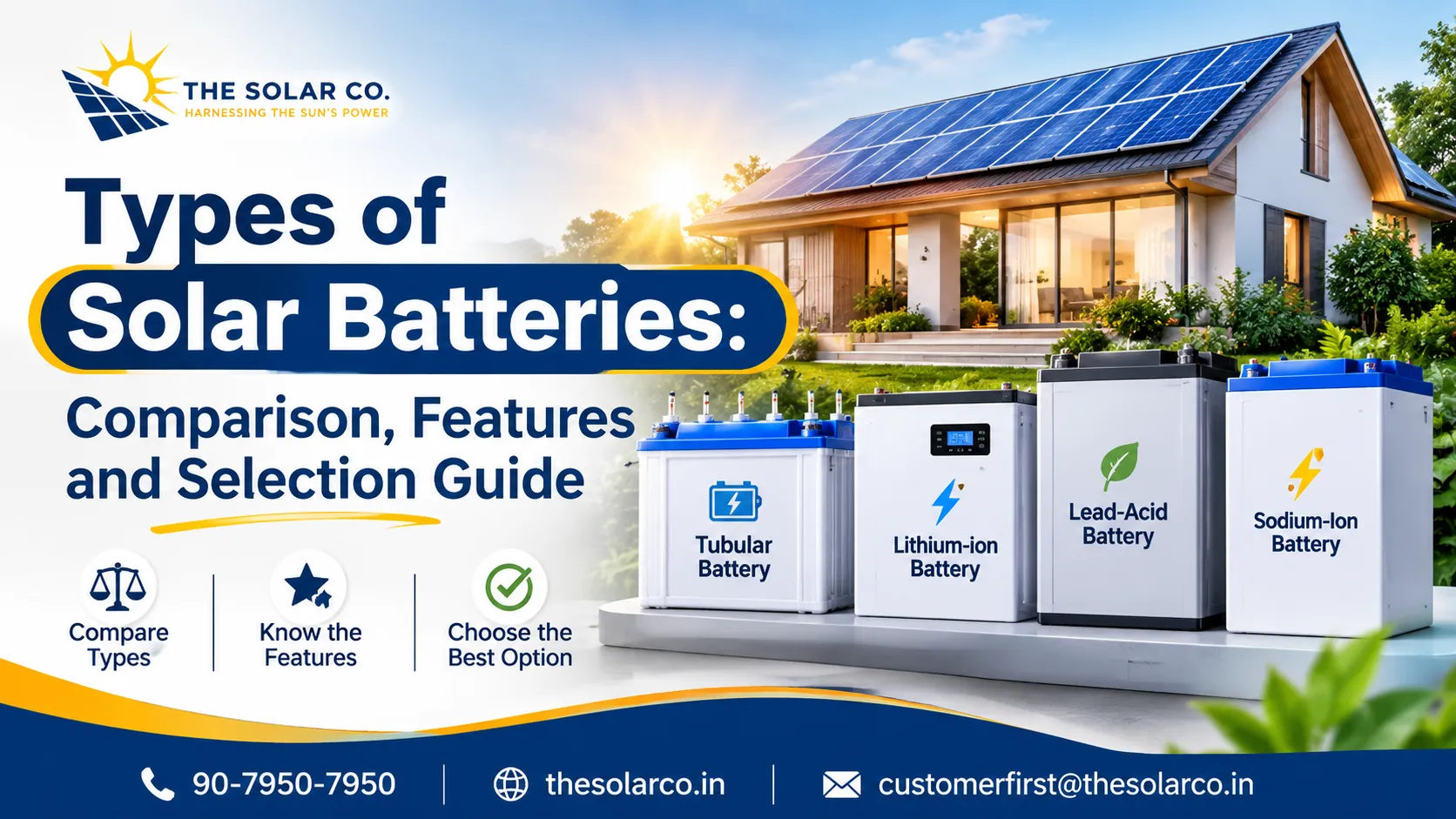
Choosing the right battery is important for getting reliable backup and better energy management from a solar power system. Understanding the types of solar batteries helps homeowners and businesses compare storage technologies according to capacity, lifespan, efficiency, maintenance, and budget. Solar batteries store excess electricity generated by photovoltaic panels and make it available when sunlight is unavailable or electricity demand increases. Lead acid and lithium batteries are two commonly considered options for solar installations. However, their performance characteristics and operating requirements differ. Before purchasing a battery, buyers should understand these differences to select a suitable storage solution for their property and long-term energy requirements.
Understanding Different Types of Solar Batteries
Solar batteries are designed to store electricity generated by solar panels for later consumption. They are particularly useful in installations where users want backup electricity, improved energy independence, or better control over when solar energy is consumed.
Role of Batteries in Solar Energy Systems
Solar panels generate electricity during daylight hours, but household and business electricity requirements continue throughout the day and night. A battery helps manage this difference by storing available electricity for later use.
In a battery-supported solar installation, excess energy can charge the battery when solar generation is higher than immediate consumption. When generation decreases, stored electricity can supply compatible electrical loads through the inverter.
The main functions of storage include:
- Backup power: Supplies electricity to selected appliances during grid interruptions when the system supports backup operation.
- Energy management: Stores available solar electricity for use during evening hours.
- Reduced grid dependence: Helps users utilize more of their own solar-generated electricity.
- Load management: Supports electricity availability during periods of higher consumption.
- Energy flexibility: Allows compatible systems to manage solar, battery, and grid electricity.
Battery performance depends on storage capacity, inverter compatibility, charging conditions, and electricity consumption patterns.
Why Battery Technology Matters
Different battery technologies use different chemical processes to store and release electrical energy. These differences influence charging speed, usable capacity, efficiency, maintenance, operating temperature, and expected service life.
For example, traditional lead acid batteries generally have a lower upfront purchase cost but may require more maintenance and careful discharge management. Lithium batteries typically offer higher usable capacity, better efficiency, and longer cycle life, although their initial investment is usually higher.
Selecting a battery without considering these characteristics can result in an unsuitable storage system.
Buyers should evaluate the complete ownership cost rather than comparing solar products only by their purchase prices. Installation requirements, replacement frequency, warranty coverage, and operating conditions also influence the overall value of a battery.
Factors That Differentiate Solar Batteries
Several technical factors help distinguish one storage product from another.
Capacity: Measured in kilowatt-hours (kWh), capacity indicates how much energy a battery can store.
Depth of Discharge (DoD): Represents the percentage of battery capacity that can be used before recharging. Higher permitted DoD can provide more usable energy.
Cycle Life: Indicates the number of charge and discharge cycles a battery can complete under specified testing conditions before reaching a defined performance threshold.
Round-Trip Efficiency: Measures how much energy can be recovered compared with the electricity used to charge the battery.
Charging Rate: Describes how quickly a battery can accept energy within its permitted operating limits.
Warranty: Specifies the manufacturer’s coverage, which may include product defects, performance guarantees, and operating conditions.
Understanding these factors makes battery comparison more practical and helps buyers select equipment according to actual energy requirements.
Lead Acid Battery for Solar Systems
Lead acid batteries are an established energy storage technology used in various backup and solar applications. They use lead-based electrodes and an electrolyte to store electrical energy through reversible chemical reactions.
Their relatively accessible purchase price makes them an option for installations where initial investment is an important consideration.
Working and Features of Lead Acid Batteries
A lead acid solar battery stores electricity through chemical reactions between lead-based plates and an electrolyte solution.
During charging, electrical energy reverses the chemical reaction and restores the battery’s stored energy. During discharge, the battery releases electricity to operate connected equipment.
There are different lead acid battery configurations, including flooded, sealed maintenance-free, AGM, and gel batteries.
Flooded batteries generally require periodic electrolyte-level inspection and suitable ventilation. Sealed varieties are designed to reduce routine maintenance requirements, although they still require appropriate operating conditions.
Common characteristics include:
- Established and widely available technology.
- Comparatively lower initial purchase cost.
- Different capacity and voltage configurations.
- Compatibility with suitable battery-based inverters.
- Regular charging and discharge management requirements.
Buyers should always check the manufacturer’s charging recommendations and installation instructions before connecting a battery to a solar system.
Advantages and Limitations
The biggest advantage of lead acid technology is its relatively affordable initial cost. It can be suitable for basic backup applications where energy requirements are predictable and the system is appropriately sized.
However, these batteries have certain limitations.
Their usable capacity may be lower than their rated capacity when manufacturers recommend limiting discharge depth. Frequent deep discharging can reduce service life.
Other considerations include:
- Generally shorter cycle life than many lithium alternatives.
- Lower usable capacity at recommended discharge limits.
- Greater weight for comparable storage capacity.
- Charging efficiency and charging time limitations.
- Periodic maintenance for certain battery configurations.
Temperature also influences battery performance. Excessive heat can accelerate degradation, making suitable placement and ventilation important.
A lower purchase price does not always mean a lower lifetime cost. Replacement frequency and maintenance expenses should also be considered.
Suitable Applications for Lead Acid Storage
Lead acid storage may suit smaller solar installations, basic backup arrangements, and applications where the initial investment needs to remain controlled.
It can be considered for selected rural properties, lighting systems, and backup applications with moderate energy requirements.
However, the battery bank must be designed according to the expected load and required backup duration.
For example, a household operating lights, fans, and communication equipment during an outage needs a different storage configuration from a property running air conditioners and water pumps.
Buyers should also consider battery placement, ventilation, accessibility, and maintenance arrangements before installation.
Lithium Battery for Solar Systems
Lithium technology has become an important option for modern solar energy storage because of its energy density, charging characteristics, and cycle performance. Lithium batteries are commonly considered in residential, commercial, and hybrid solar installations where efficient energy storage is a priority.
Features of Lithium Battery Technology
Lithium batteries store electricity through the movement of lithium ions between electrodes during charging and discharging.
Several lithium chemistries are available. Lithium iron phosphate, commonly called LFP or LiFePO4, is widely used in stationary energy storage applications because of its thermal stability and cycle-life characteristics.
A modern lithium battery generally includes a Battery Management System (BMS). This electronic system monitors important operating conditions and helps protect the battery against issues such as overcharging, excessive discharge, and abnormal temperature.
Important features include:
- High energy density compared with many traditional lead acid products.
- Greater usable capacity in suitable configurations.
- Integrated battery monitoring and protection.
- Faster charging capabilities within manufacturer limits.
- Relatively low routine maintenance requirements.
Not every lithium product offers identical performance. Buyers should check the exact chemistry, BMS functionality, operating temperature range, and manufacturer’s technical documentation.
Performance and Efficiency Benefits
A major advantage of lithium technology is its ability to provide more usable energy from its rated capacity when compared with many conventional lead acid configurations.
For example, a battery with a 10kWh nominal capacity may offer different usable energy depending on its permitted discharge depth. A lithium product with an approved 90% usable depth could provide approximately 9kWh before accounting for other system losses.
Lithium batteries also commonly provide higher round-trip efficiency, helping reduce energy losses during storage and discharge.
Other performance benefits may include:
- Longer cycle life under specified operating conditions.
- Compact design for available installation space.
- Lower routine maintenance requirements.
- Consistent performance when operated within recommended limits.
- Suitable charging and discharging flexibility.
Actual performance depends on battery chemistry, operating temperature, charge rates, installation conditions, and usage patterns.
Applications in Modern Solar Systems
Lithium storage is increasingly used in residential hybrid systems, commercial energy installations, and applications where regular battery cycling is expected.
Homeowners may use compatible lithium batteries to store daytime solar generation and operate selected appliances after sunset.
Businesses can consider storage for backup requirements, energy management, and selected load-support applications.
However, the battery must be compatible with the inverter’s communication protocol, voltage range, charging settings, and power requirements.
The Solar Co. provides solar energy solutions for residential and institutional applications. Buyers exploring a solar company in Jaipur should evaluate the complete system design, including panels, inverters, battery integration, installation, and technical support, rather than choosing storage equipment independently.
Comparing Solar Battery Technologies and Selecting the Best Option
Comparing battery technologies requires more than checking their purchase prices. Buyers should consider usable energy, service life, efficiency, maintenance, installation conditions, and compatibility with their solar equipment.
Difference in Lifespan and Maintenance
Battery lifespan is generally influenced by cycle count, temperature, discharge depth, charging conditions, and maintenance practices.
Lead acid products often require more careful discharge management. Flooded varieties also need periodic inspection and maintenance according to manufacturer instructions.
Lithium batteries, particularly LFP models, generally offer longer cycle life under suitable operating conditions. Their integrated BMS also helps manage important operating parameters.
When comparing expected service life, check the manufacturer’s cycle-life rating and the conditions under which it was measured. A cycle-life figure should not be treated as a guaranteed number of years.
Installation quality and operating temperature remain important for both technologies.
Cost and Performance Comparison
The purchase price is only one part of the overall battery investment. Buyers should compare the cost of usable stored energy and expected lifetime performance.
| Comparison factor | Lead acid | Lithium |
|---|---|---|
| Initial cost | Generally lower | Generally higher |
| Usable capacity | Often lower | Often higher |
| Cycle life | Generally shorter | Generally longer |
| Maintenance | Depends on battery type; may be higher | Generally lower |
| Energy efficiency | Generally lower | Generally higher |
| Weight | Generally heavier | Generally lighter |
| BMS | Not typically integrated | Commonly included |
These are general comparisons, not guaranteed specifications for every product.
A lead acid battery may suit buyers prioritizing lower upfront expenditure. Lithium may offer better long-term value when frequent cycling, higher usable capacity, and reduced maintenance are important.
Understanding Backup Needs and System Compatibility
Before selecting a battery, calculate how much electricity must be available during backup periods.
Start by identifying essential appliances such as lights, fans, refrigerators, computers, and communication equipment. Record their power ratings and estimated daily operating hours.
Multiply appliance wattage by operating hours to estimate energy consumption in watt-hours. Add the requirements of all selected appliances to calculate the expected backup demand.
Next, check the inverter’s battery voltage, supported chemistry, charging current, and communication compatibility.
A suitable battery must also provide sufficient discharge power to support the connected loads. Storage capacity alone does not determine whether an appliance can operate properly.
Considering Future Energy Requirements
Energy consumption may increase when households add air conditioners, electric vehicle chargers, appliances, or additional electrical equipment. Businesses may also expand operations and introduce machinery that increases electricity demand.
Therefore, consider whether the selected battery system supports future expansion.
Check whether additional battery modules can be connected, whether the inverter supports increased storage capacity, and whether the installation has sufficient space and electrical infrastructure.
Warranty conditions, product availability, technical support, and replacement costs should also be reviewed.
The best battery is not necessarily the one with the highest capacity or lowest price. It is the option that provides suitable usable energy, dependable performance, compatible operation, and reasonable lifetime costs.
By comparing lead acid and lithium technologies carefully, homeowners and businesses can select an appropriate solar storage solution that supports their backup expectations and long-term energy goals.