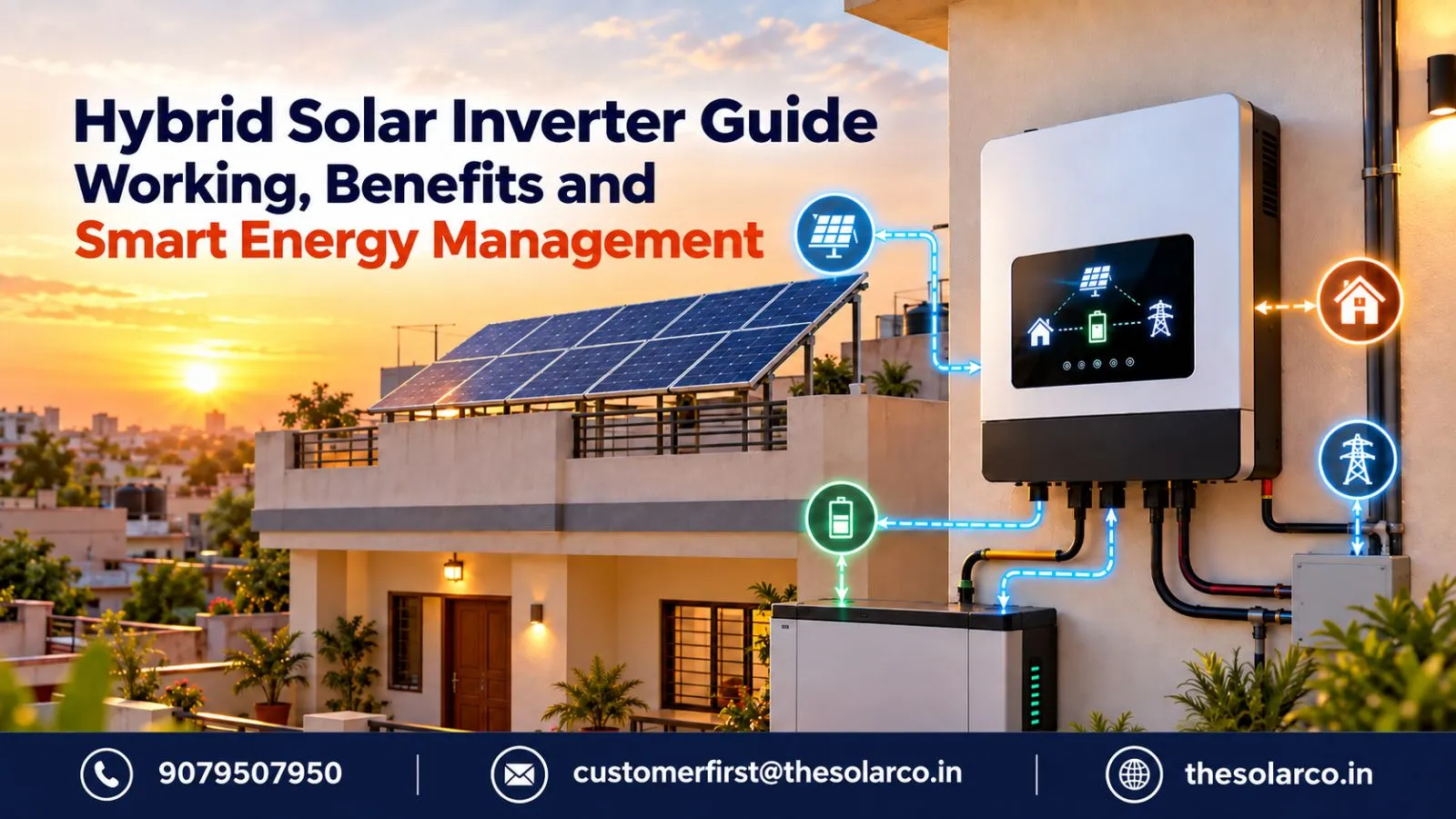
A hybrid solar inverter combines solar power conversion, battery management, and grid interaction in one energy-management system. Instead of using solar electricity only when it is being generated, a hybrid system can direct surplus solar energy into a battery and use stored electricity when solar production falls or backup power is required.
This makes hybrid solar technology particularly relevant as energy storage becomes a larger part of India’s renewable-energy landscape. India had 32.59 GW of grid-connected rooftop solar capacity by August 31, 2026, while cumulative battery energy storage capacity reached 9.3 GWh by June 2026.
For homeowners and businesses, the main advantage is not simply having a battery. It is having an inverter that can intelligently coordinate solar generation, electricity demand, battery storage, and grid supply.
What Is a Hybrid Solar Inverter?
Understanding Hybrid Inverter Technology
A hybrid inverter is designed to manage electricity from multiple sources and loads.
In a typical solar-plus-storage system, the inverter can receive DC electricity from the solar panels, manage battery charging and discharging, and supply AC electricity to the property’s loads. It can also interact with the utility grid when the system is grid-connected.
This creates a more flexible energy system than a basic solar installation.
Depending on the model and configuration, a hybrid inverter may support:
- Solar PV input
- Battery storage
- Grid connection
- Backup loads
- Energy monitoring
- Battery charging and discharging controls
- Remote monitoring
- Programmable operating modes
The exact capabilities vary by inverter model, battery chemistry, system design, and local electrical requirements.
Difference Between Normal and Hybrid Inverter
A conventional grid-tied solar inverter primarily converts electricity generated by solar panels into usable AC electricity and synchronizes with the grid.
A hybrid inverter adds battery-management capabilities to this architecture.
The difference can be simplified as:
Standard solar inverter:
Solar → Inverter → Loads/Grid
Hybrid solar inverter:
Solar → Hybrid Inverter → Loads + Battery + Grid
This does not mean every hybrid inverter provides the same backup functionality. Some systems can supply selected loads during a grid outage, while others may have different backup limitations.
Therefore, backup capability should always be checked as part of the complete system design.
Role of Battery Integration in Hybrid Systems
The battery gives a hybrid system the ability to shift solar energy from one time period to another.
For example, solar generation may be high around midday while household electricity demand is relatively low. Instead of sending all surplus energy elsewhere, a compatible hybrid system can charge the battery.
Later, when solar generation falls, stored energy can be used.
Battery integration can therefore help increase the amount of solar energy that is available when the sun is not producing enough power.
Battery compatibility is important. The inverter must support the battery’s voltage range, communication requirements, charging characteristics, and chemistry.
How Hybrid Solar Inverter Works
Managing Solar Power, Battery and Grid Supply
A hybrid inverter continuously manages available energy according to the system’s configuration and programmed operating mode.
During strong sunlight, solar energy can first serve the property’s active loads. If solar generation exceeds the immediate demand, the system may charge the battery.
Once the battery reaches its configured charging level, excess energy may be exported to the grid where permitted and where the system is designed for grid export.
When solar production decreases, the system can use stored battery energy or draw electricity from the grid, depending on the selected operating strategy.
This creates an energy-management cycle rather than a simple one-way electricity flow.
Energy Storage and Backup Process
One of the most useful features of a hybrid system is energy storage.
Consider a typical evening:
Daytime:
Solar generates electricity → household uses solar → surplus charges battery
Evening:
Solar generation decreases → battery supplies selected loads
Low battery:
System can switch to grid supply according to its settings
During a grid outage, a hybrid inverter with suitable backup capability can continue supplying designated loads from solar and/or battery storage.
However, backup operation depends on the inverter architecture, battery capacity, backup output rating, changeover design, and which loads are connected to the backup circuit.
Automatic Switching Between Power Sources
Modern hybrid inverters can automatically manage different power sources according to programmed priorities.
Common operating strategies may include:
- Solar-first operation
- Battery-first during selected periods
- Grid support
- Backup reserve
- Time-of-use charging
- Scheduled battery charging and discharging
The actual options depend on the inverter and battery system.
This automatic coordination is what makes a hybrid system different from simply adding a battery to a conventional solar setup.
Benefits of Using Hybrid Solar Inverter
Better Energy Control and Flexibility
A hybrid inverter provides greater control over when and how solar electricity is used.
Instead of treating solar generation and electricity consumption as separate events, the system can coordinate them.
For example, a homeowner may configure the system to:
- Use solar power for current loads.
- Charge the battery using surplus solar.
- Preserve a defined battery reserve.
- Use stored energy during selected periods.
- Draw grid electricity when battery conditions require it.
This flexibility can become increasingly useful as electricity demand patterns change.
Backup Power During Electricity Failure
Backup capability is one of the most common reasons people consider a hybrid system.
When the grid fails, a compatible hybrid inverter can isolate the backup circuit from the grid and supply selected loads using battery energy and available solar generation.
The important word is selected.
A battery system should not automatically be expected to operate an entire building. High-power appliances such as air conditioners, pumps, heaters, or electric vehicle chargers can require substantial capacity.
Backup loads should therefore be identified before selecting inverter and battery capacity.
Improved Solar Energy Utilization
A conventional solar system may generate a large amount of electricity when demand is low.
Battery storage gives the system another option: store some of that energy for later use.
This can increase the practical use of self-generated solar electricity, particularly for properties where daytime solar generation and evening electricity consumption do not match.
India’s growing emphasis on energy storage reflects this broader shift. MNRE notes that energy storage can support renewable integration, peak shifting, grid stability, and better use of variable renewable generation.
Hybrid Solar Inverter Selection Factors
Choosing Inverter Capacity According to Load
Inverter capacity should be selected based on the property’s actual electrical requirements, not simply the number of solar panels.
Consider:
- Connected load
- Peak demand
- Starting current of motors
- Essential backup loads
- Solar PV capacity
- Battery capacity
- Future electricity requirements
For backup applications, the peak demand of the selected loads is especially important.
A system that can support lighting and essential appliances may require a very different inverter configuration from one expected to support pumps, air conditioners, refrigeration, or other high-power equipment.
A professional load assessment can help determine the appropriate inverter size.
Battery Compatibility Requirements
Battery selection is one of the most important parts of a hybrid system.
Check compatibility for:
- Battery voltage
- Usable capacity
- Chemistry
- Maximum charging current
- Maximum discharge current
- Communication protocol
- Battery management system compatibility
- Operating temperature range
- Warranty requirements
Lithium-ion batteries, including lithium iron phosphate (LFP) systems, are increasingly used in energy-storage applications, but the appropriate technology depends on the application and compatible equipment.
The usable battery capacity is also more important than simply looking at the battery’s headline capacity. The amount of energy available to the loads depends on the battery’s usable operating range and system efficiency.
Efficiency and Smart Features Comparison
Efficiency matters because energy is lost during conversion and storage.
When comparing hybrid inverters, look beyond the headline efficiency figure. Consider how the complete system operates under real conditions.
Useful features may include:
- Multiple operating modes
- Remote monitoring
- Battery state-of-charge monitoring
- Backup reserve settings
- Time-based energy management
- Fault notifications
- Solar and battery data logging
- Load monitoring
For long-term ownership, reliable monitoring can be particularly valuable because it helps users understand how the system is actually operating.
Hybrid Solar Inverter Applications
Residential Solar Energy Systems
Hybrid solar inverters are suitable for homes that want a combination of solar generation, energy storage, and backup capability.
They can be useful when:
- Grid interruptions are a concern
- Evening electricity consumption is significant
- The homeowner wants greater solar self-consumption
- Essential appliances need backup
- The property has changing electricity demand
The system should be designed around actual household consumption rather than simply maximizing battery size.
A smaller battery with carefully selected backup loads may be more appropriate for one home, while another property may require substantially more storage.
Commercial Energy Solutions
Commercial buildings can have a very different electricity profile from homes.
Offices, shops, clinics, warehouses, restaurants, and industrial facilities may have significant daytime loads and specific requirements for backup and energy management.
A hybrid system can coordinate solar generation and storage while providing additional control over electricity use.
For commercial applications, the analysis should include:
- Load profile
- Operating hours
- Peak demand
- Backup requirements
- Solar generation profile
- Battery cycling requirements
- Expansion plans
The financial evaluation should consider the complete operating profile rather than judging the system only by its battery capacity.
Future-Ready Solar Power Management
Hybrid inverters are part of a broader movement toward intelligent energy management.
Solar systems are increasingly being connected to monitoring platforms, batteries, smart meters, and digital control systems. This allows energy decisions to be based on real operating data rather than simple fixed schedules.
India’s energy-storage requirements are also expected to grow substantially. MNRE cites CEA projections of 82.37 GWh of storage requirement in 2026–27, rising to 411.4 GWh in 2031–32.
This does not mean every rooftop system needs a large battery. Instead, it shows why storage-aware system design is becoming an increasingly important part of the solar industry.
Hybrid Solar Inverter: A Practical Decision Checklist
Before choosing a hybrid system, evaluate:
- Current electricity consumption
- Peak electrical load
- Required backup loads
- Solar PV capacity
- Desired battery capacity
- Battery chemistry and compatibility
- Inverter output rating
- Backup output capability
- Monitoring features
- Future electricity requirements
- Installation and maintenance requirements
A hybrid inverter should be selected as part of a complete solar-plus-storage system rather than as an isolated piece of equipment.
Conclusion
A hybrid solar inverter turns a solar installation into a more flexible energy-management system by coordinating solar generation, battery storage, loads, and grid electricity.
Its real value comes from this coordination. Solar power can serve immediate demand, surplus energy can be stored, and the battery can later support selected loads when solar production is lower or the grid is unavailable.
As India’s solar and energy-storage sectors continue to expand, hybrid systems are becoming increasingly relevant for homes and businesses looking for greater control over how electricity is generated, stored, and consumed.
The best hybrid system is not necessarily the one with the largest inverter or battery. It is the one correctly matched to the property’s load profile, solar generation, backup requirements, battery technology, and future energy needs.
Frequently Asked Questions
What is a hybrid solar inverter?
A hybrid solar inverter manages solar electricity, battery storage, and grid power within one integrated system. Depending on its design, it can also provide backup power during grid outages.
Can a hybrid inverter work without a battery?
Some hybrid inverters can operate without an installed battery, depending on the manufacturer’s specifications and configuration. However, battery-based energy storage and backup features require a compatible battery system.
Does a hybrid inverter provide backup during a power cut?
A compatible hybrid inverter can provide backup power, but the exact capability depends on the inverter, battery, backup circuit, and system configuration. Not every hybrid inverter automatically powers the entire property during an outage.
How do I choose the right hybrid inverter size?
Start with the property’s peak load, essential backup loads, solar capacity, and future electricity requirements. High-starting-current appliances may require additional inverter capacity.
Is a hybrid solar inverter useful for commercial buildings?
It can be useful for commercial buildings that want to combine solar generation, battery storage, backup power, and energy management. The appropriate configuration depends on the building’s load profile and operating requirements.