
Solar power has become an increasingly important part of the transition towards cleaner energy. However, solar panels generate electricity primarily when sunlight is available, while household and business electricity demand can continue throughout the day and night. This difference between generation and consumption creates a need for effective energy storage.
Solar energy storage solutions help capture surplus electricity generated by solar panels and make it available when solar production is low or unavailable. Depending on the system, stored energy can be used during evenings, cloudy periods, power outages, or times of higher electricity demand.
Modern storage systems range from traditional battery-based solutions to hybrid configurations and emerging technologies. The right option depends on factors such as energy consumption, required backup duration, solar system configuration, available space, budget, and expected usage patterns.
For homeowners, businesses, and industries, energy storage can improve the usefulness of solar power by allowing more of the generated electricity to be consumed when it is actually needed. It can also support backup power and reduce dependence on grid electricity.
This guide explains how solar energy storage works, the major storage technologies available, their benefits, important selection factors, and the future of energy storage in India.
What Are Solar Energy Storage Solutions?
Solar energy storage solutions are systems designed to store electricity generated by solar panels for later use. Instead of immediately consuming all the electricity produced during daylight hours, surplus energy can be stored and discharged when required.
The most common storage technology used with solar systems is battery storage. However, the broader energy storage market also includes technologies such as pumped hydro, thermal storage, and other emerging solutions.
For residential and commercial solar installations, battery energy storage systems are generally the most practical option because they can be installed close to the point of electricity consumption.
Understanding Solar Energy Storage Systems
A solar energy storage system typically works by connecting solar generation, energy storage, household or business loads, and the electrical grid.
During periods of strong sunlight, solar panels generate electricity. The system first supplies the connected loads. If solar generation exceeds immediate consumption, the surplus electricity may be directed towards the battery.
When solar generation falls, the stored energy can be discharged to power connected appliances or equipment.
A simplified energy flow looks like this:
Solar Panels → Inverter → Electrical Loads
When surplus power is available:
Solar Panels → Battery Storage → Later Use
Depending on the system configuration, electricity may also flow between the grid and the battery.
The exact operation depends on whether the installation is grid-connected, hybrid, or off-grid.
Why Storing Solar Power Is Important
Without storage, solar electricity generated during the day may need to be consumed immediately or exported to the grid, depending on the system configuration and applicable regulations.
However, many households consume more electricity during the evening, when solar generation has already declined.
Storage helps bridge this timing gap.
For example, a home may generate surplus electricity around midday when residents are away at work. In the evening, electricity demand may increase because of lighting, appliances, cooling, and entertainment.
A battery can store some of the midday surplus and make it available later.
This can increase the percentage of solar energy that is directly used by the property instead of relying entirely on grid electricity during non-solar hours.
Role of Storage in Improving Energy Usage
Energy storage gives users greater control over when electricity is consumed.
Instead of using solar power only when it is generated, users can store energy and use it according to their consumption patterns.
Storage can support:
- Evening electricity consumption
- Backup power during outages
- Better use of surplus solar generation
- Peak demand management
- Greater energy independence
- Integration of additional renewable energy
For businesses, storage can also support energy management strategies where electricity demand changes throughout the working day.
The value of storage therefore depends not only on how much energy a system can store but also on when that energy is available and how it is used.
Different Types of Solar Energy Storage Systems
Solar storage systems can be classified based on their technology and configuration.
The most suitable option depends on the user’s energy requirements, backup expectations, existing solar installation, and budget.
Battery-Based Solar Storage Solutions
Battery storage is the most common option for residential and commercial solar applications.
Different battery chemistries are available, with lithium-ion technology widely used in modern energy storage applications.
Lithium iron phosphate, commonly known as LFP, is also increasingly used because of its characteristics related to safety, cycle life, and thermal stability.
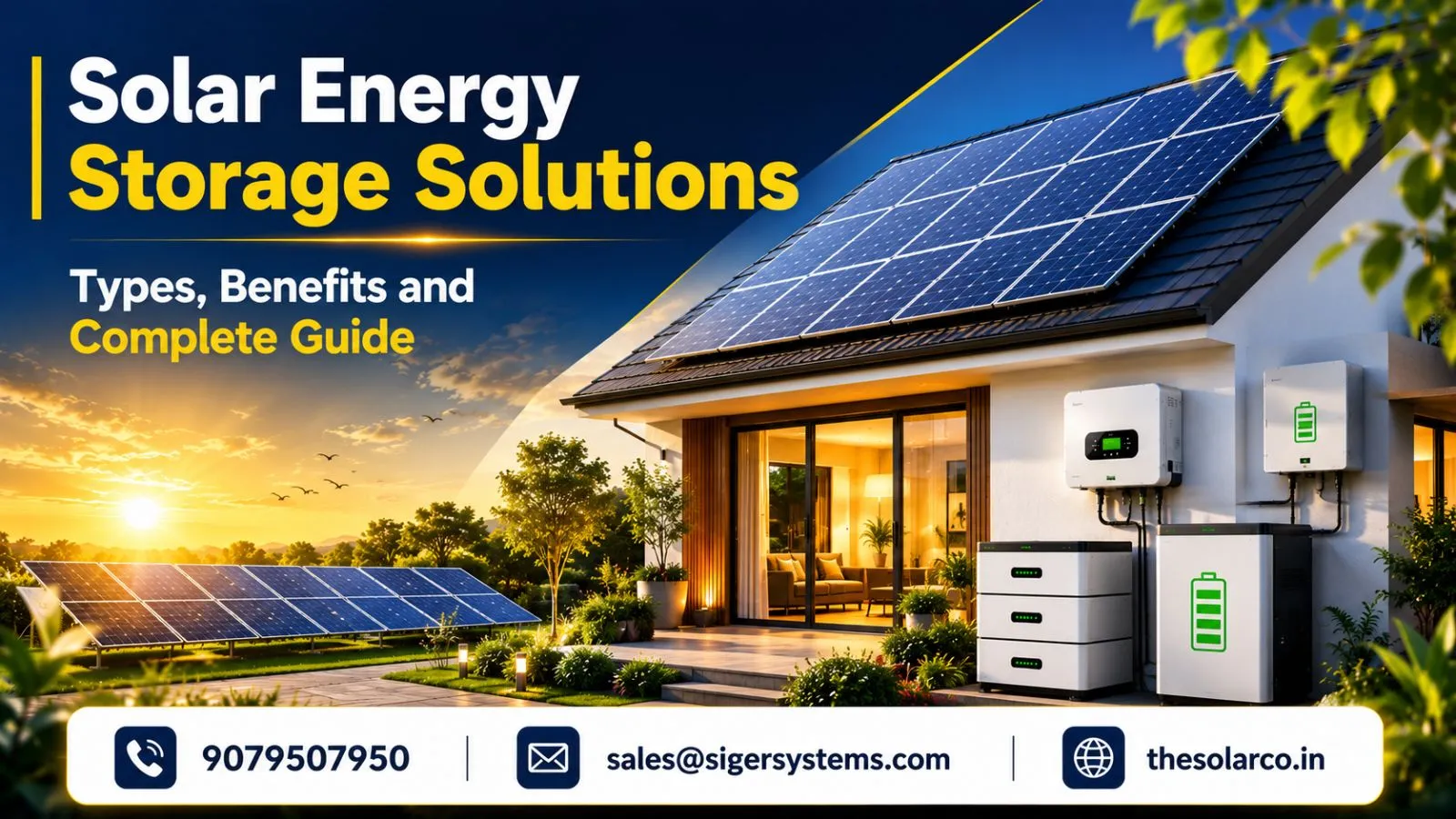
Battery systems generally include:
- Battery modules
- Battery management system
- Inverter or power conversion system
- Monitoring controls
- Safety and protection equipment
When selecting a battery, users should consider usable capacity rather than only the advertised total capacity.
For example, a battery’s nominal capacity may be higher than the amount of energy the system is designed to regularly deliver.
Other important factors include cycle life, warranty, operating temperature, charging efficiency, and maintenance requirements.
Hybrid Solar Energy Storage Systems
Hybrid solar systems combine solar generation, battery storage, and grid connectivity in a single energy management setup.
These systems can provide flexibility because they can manage electricity from multiple sources.
Depending on the configuration, a hybrid system may:
- Supply electricity directly from solar panels
- Charge the battery using solar power
- Use stored electricity during non-solar hours
- Draw power from the grid when necessary
- Provide backup power during outages
Hybrid systems are particularly useful for households and businesses that want both solar generation and energy backup.
However, not every hybrid inverter provides backup power to the entire property.
The system must be designed according to the required backup loads. Critical appliances such as lights, refrigerators, internet equipment, and selected electrical circuits may be prioritised.
Advanced Energy Storage Technologies
Beyond conventional batteries, the energy storage industry is developing several advanced technologies.
These include:
- Flow batteries
- Sodium-ion batteries
- Thermal energy storage
- Hydrogen-based energy storage
- Pumped hydro storage
- Compressed air energy storage
Some technologies are more suitable for large-scale grid applications than residential installations.
For example, pumped hydro can provide large-scale energy storage but requires specific geographical conditions.
Flow batteries may be attractive for certain long-duration applications, while sodium-ion technology is receiving attention because of its potential material and supply-chain advantages.
For most residential solar users today, battery energy storage remains the most practical option.
However, technological improvements could expand the range of storage solutions available in the coming years.
How Solar Storage Improves Energy Independence
Solar panels reduce dependence on grid electricity, but storage can further improve energy independence by allowing solar energy to be used beyond daylight hours.
This is particularly useful when household electricity demand does not match solar production.
Using Stored Power During Non-Sunlight Hours
Solar panels generally generate the most electricity during daylight hours.
However, households often consume significant electricity in the evening.
Storage can help shift solar energy from daytime to evening consumption.
For example, a home may use solar energy to charge a battery during the afternoon. After sunset, the battery can supply electricity for selected household loads.
The amount of backup available depends on:
- Battery capacity
- Household consumption
- Number of connected appliances
- Battery state of charge
- System efficiency
A battery sized for a few essential loads can provide backup for longer than the same battery powering the entire home.
This makes accurate load planning important when designing a storage system.
Reducing Dependency on Traditional Electricity Sources
Solar storage can reduce grid dependency by increasing the amount of solar energy consumed on-site.
For example, electricity generated during the day can be stored and used later instead of immediately drawing electricity from the grid after sunset.
However, energy independence does not always mean complete disconnection from the grid.
Many users prefer a grid-connected system because it provides additional reliability when solar generation and battery capacity are insufficient.
The ideal level of grid independence depends on the user’s priorities.
Some users may focus on reducing electricity bills, while others may prioritise backup power or energy resilience.
Managing Energy Demand With Storage Systems
Energy storage can help manage electricity demand by shifting consumption to more suitable times.
For example, a business may use stored energy during periods of high electricity demand and recharge the battery when solar generation is strong.
This approach can potentially reduce peak demand in suitable commercial applications.
Smart energy management systems can automate these decisions.
They can monitor:
- Solar generation
- Battery charge levels
- Electricity consumption
- Grid availability
- Time-based electricity tariffs
The system can then determine when to charge or discharge the battery based on predefined priorities.
This makes energy storage more than a backup solution. It becomes part of a broader energy management strategy.
Factors to Consider Before Choosing Solar Storage
Selecting a battery should not be based solely on its advertised capacity.
Users should consider their electricity consumption patterns, backup requirements, system compatibility, expected battery life, and long-term operating costs.
Storage Capacity and Power Requirements
Storage capacity is measured in kilowatt-hours, or kWh, and indicates how much energy a battery can store.
Power capacity, measured in kilowatts, or kW, indicates how much electricity the system can deliver at a given moment.
These are different specifications.
For example, a battery may have sufficient energy capacity for several hours of basic consumption but may not be able to power multiple high-load appliances simultaneously if its output power is limited.
Before selecting a system, identify:
- Essential backup loads
- Total daily electricity consumption
- Peak electricity demand
- Required backup duration
- Expected solar generation
A professional energy assessment can help determine an appropriate battery size.
Battery Life and Performance Factors
Battery performance changes over time.
Important factors include:
- Cycle life
- Depth of discharge
- Operating temperature
- Charging and discharging efficiency
- Warranty period
- Battery chemistry
- Maintenance requirements
Lithium-based systems are popular partly because of their high efficiency and relatively long cycle life.
However, users should review the manufacturer’s warranty conditions carefully.
The warranty may specify a maximum number of cycles, minimum remaining capacity, or operating conditions.
Battery performance can also be affected by temperature.
Proper installation and thermal management can therefore be important for long-term performance and safety.
Compatibility With Existing Solar Systems
Not every battery can be connected directly to every existing solar installation.
Compatibility may depend on:
- Inverter type
- Battery voltage
- Communication protocols
- System architecture
- Backup requirements
- Electrical configuration
A home with an existing grid-connected solar system may need additional equipment to integrate battery storage.
In some cases, replacing or upgrading the inverter may be more practical.
Before purchasing a battery, homeowners should confirm compatibility with their existing solar equipment.
A qualified installer can assess the system and recommend an appropriate configuration.
Future of Solar Energy Storage in India
India’s growing renewable energy capacity is increasing the importance of energy storage.
Solar generation is variable, while electricity demand continues throughout the day.
Energy storage can help bridge this gap and support a more flexible electricity system.
Growing Demand for Energy Backup Solutions
Power reliability remains an important consideration for many residential and commercial users.
Solar-plus-storage systems can provide backup electricity during grid outages when designed with appropriate backup functionality.
Demand may increase as more households adopt solar power and as electricity consumption grows.
The expansion of electric vehicles could also influence storage demand.
For example, households with solar panels and EVs may explore ways to coordinate solar generation, battery storage, and vehicle charging.
This could create more sophisticated energy management systems.
However, the economics of each application will depend on battery prices, electricity tariffs, grid reliability, and local regulations.
Role of Storage in Renewable Energy Growth
As renewable energy becomes a larger part of the electricity mix, storage can help manage the difference between energy generation and demand.
Solar power is naturally variable.
Generation changes according to:
- Time of day
- Weather
- Season
- Cloud cover
Energy storage can help shift electricity from periods of high renewable generation to periods of higher demand.
At a larger scale, storage can support grid stability and improve the flexibility of renewable energy systems.
This makes storage an important component of the broader clean energy transition.
Smart Energy Management Possibilities
Future solar storage systems are expected to become increasingly intelligent.
Smart energy management can use real-time information to optimise how electricity flows between solar panels, batteries, appliances, and the grid.
Future systems may increasingly integrate:
- Smart meters
- Energy management software
- Artificial intelligence
- Internet of Things devices
- Electric vehicles
- Dynamic electricity pricing
For example, an intelligent system could analyse weather forecasts and electricity demand to determine when to charge or discharge a battery.
Homes may also use smart controls to prioritise solar power for specific appliances or automatically schedule energy-intensive activities.
As these technologies develop, solar storage could become an integrated part of smart energy ecosystems rather than a standalone backup system.
Conclusion
Solar energy storage is becoming an increasingly important part of modern renewable energy systems. While solar panels generate electricity during periods of sunlight, storage allows that energy to be used when generation is lower or unavailable.
Battery-based systems are currently the most practical option for many residential and commercial applications. Hybrid systems can combine solar generation, battery storage, and grid electricity to provide greater flexibility.
Choosing the right storage system requires careful consideration of capacity, power output, battery life, compatibility, backup requirements, and expected usage patterns.
For homeowners, the objective may be to use more solar energy after sunset or maintain essential electricity supply during outages. For businesses, storage can support energy management and potentially reduce peak demand.
India’s growing renewable energy sector is likely to increase the importance of storage technologies. As batteries become more advanced and smart energy management improves, solar-plus-storage systems may play a greater role in homes, businesses, and the wider electricity grid.
Before investing in a storage system, users should assess their electricity consumption and clearly define their objectives. Professional system design can help ensure that the selected battery and solar equipment work together safely and efficiently.
Frequently Asked Questions About Solar Energy Storage Solutions
1. What are solar energy storage solutions?
Solar energy storage solutions store electricity generated by solar panels for later use. Battery energy storage systems are the most common option for homes and businesses, allowing solar power to be used when sunlight is unavailable.
2. How long can a solar battery provide backup power?
Backup duration depends on battery capacity, usable energy, system efficiency, and the electricity consumption of connected appliances. A battery powering only essential loads can generally provide backup for longer than one supplying the entire property.
3. Can I add a battery to my existing solar system?
In many cases, battery storage can be added to an existing solar system, but compatibility must be checked. The inverter, electrical configuration, battery technology, and backup requirements may determine the best integration method.
4. Are solar batteries worth installing in India?
The value depends on electricity consumption, grid reliability, battery costs, electricity tariffs, and the user’s objectives. Batteries may be particularly useful for backup power or increasing the use of self-generated solar electricity.
5. What is the future of solar energy storage in India?
The future is expected to include wider adoption of battery storage, smarter energy management, renewable energy integration, electric vehicle coordination, and advanced storage technologies as India’s clean energy infrastructure develops.